





Recent Public Posts - [guest]
| Re: Swindon <-> Westbury service updates and amendments, ongoing discussion - 2026 In "TransWilts line - Swindon, Chippenham, Melksham, Trowbridge, Westbury, Salisbury" [377009/31359/18] Posted by grahame at 17:10, 13th July 2026 |      |
The 15:14 Swindon Westbury hasn't departed yet, still shown as Delayed.
13:09 Gloucester to Weymouth due 16:26
13:09 Gloucester to Weymouth due 16:26 will be diverted between Bath Spa and Trowbridge.
It will no longer call at Bradford-On-Avon but will call additionally at Chippenham and Melksham.
It has been previously delayed, is being further delayed between Bath Spa and Trowbridge and is now expected to be 34 minutes late.
This is due to a road vehicle colliding with a bridge.
13:09 Gloucester to Weymouth due 16:26 will be diverted between Bath Spa and Trowbridge.
It will no longer call at Bradford-On-Avon but will call additionally at Chippenham and Melksham.
It has been previously delayed, is being further delayed between Bath Spa and Trowbridge and is now expected to be 34 minutes late.
This is due to a road vehicle colliding with a bridge.
Passengers from Bristol - through train to Melksham, Looks like it left Temple Meads at 14:26, reached Melksham perhaps an hour later. Sadly, it probably wasn't advertised as such ... so not usable as a through service for passengers.
| Re: Current service - fit for purpose? - an example In "TransWilts line - Swindon, Chippenham, Melksham, Trowbridge, Westbury, Salisbury" [377008/32231/18] Posted by grahame at 15:51, 13th July 2026 Already liked by Mark A | |
Sounds simple. Many moons ago I seem to remember that a few of our bus runs were timed for a five minute train connection wait. From memory, traffic and passenger delays meant we rarely arrived on time. Usually arrived well after our departure time, regardless of whether the train had come (or gone).
So we would arrive late (frequently very late), pick up whoever was there, and go.
If you are going to task a bus to wait for a train, it would have to be a dedicated driver and vehicle, and would wait until the train arrived, regardless of the bus schedule that was to follow that timetable.
Too many variables unfortunately.
I agree that many part sound a lot simpler than they are.
With an hourly service on one of the legs, and perhaps a more frequent service on the connecting leg, it becomes less of a problem. With the train gaps being two and a half hours in one direction, and two and a quarter in the other direction, and with a fixed appointment (of "interview" importance) at the end, it was / is not clever.
As service reliability improves (remember, that's big thing that the magic wand of nationalisation is set to bring), the connection problem is not entirely eliminated but it should be a degree or two less.
Certainly network co-ordination should help. After my appointment and my walk via Coate Water to Old Town, I picked up the bus from there to Devizes which runs every hour on a Sunday and I got home even before the next train would have left Swindon. I couldn't help but notice that 2 buses an hour were leaving the stop in Swindon for or via Wroughton at 4 and 59 minutes after the hour. Sound OK - until you note that the gap between them is 5 minutes or 55 (I grant they take different routes), that the real time display was out of action, and the times for the Devizes bus were on a poster in which the minutes after the hour were hidden by the frame!
| Re: Swindon <-> Westbury service updates and amendments, ongoing discussion - 2026 In "TransWilts line - Swindon, Chippenham, Melksham, Trowbridge, Westbury, Salisbury" [377007/31359/18] Posted by grahame at 15:37, 13th July 2026 | |
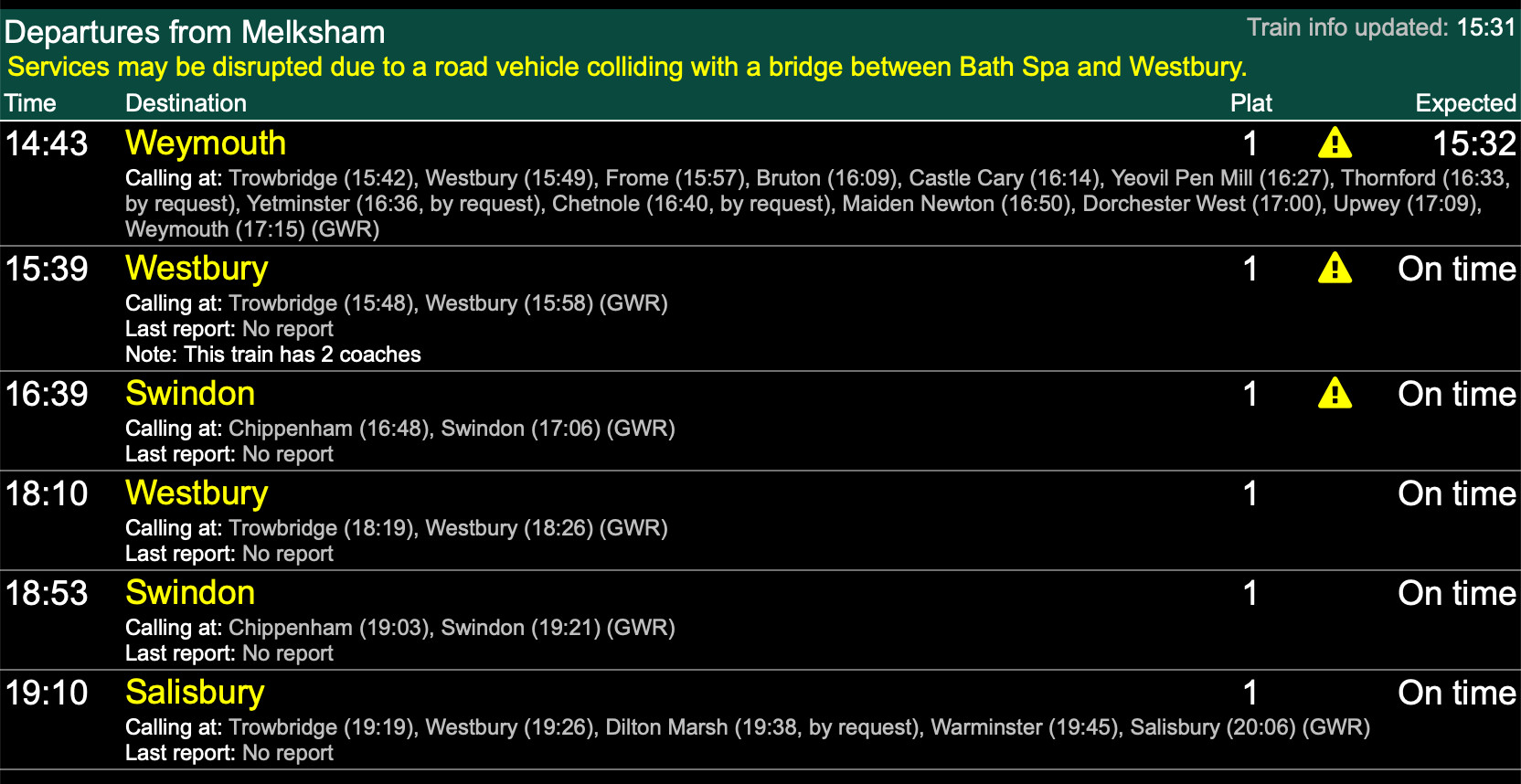
Journeycheck says nothing about services via Melksham, but the Real Time Trains site declares for the 14:18 WSB -> SWI
This service is cancelled.
This service was cancelled due to a bridge strike (XP).
This service was cancelled due to a bridge strike (XP).
And the departure board offers
| Re: Swindon <-> Westbury service updates and amendments, ongoing discussion - 2026 In "TransWilts line - Swindon, Chippenham, Melksham, Trowbridge, Westbury, Salisbury" [377006/31359/18] Posted by JohnM at 15:29, 13th July 2026 | |
The 15:14 Swindon Westbury hasn't departed yet, still shown as Delayed.
| Re: Toll bridges - charges and fines In "The Wider Picture in the United Kingdom" [377005/32224/51] Posted by stuving at 14:44, 13th July 2026 | |
The current bridge has a predecessor - a toll bridge, again of iron or steel, that carried the road across the river Mersey.
In the process of building the Manchester Ship Canal, the course of the river was filled in and its water taken via the new canal with a new bridge, the current one, augmenting the old. I've used the word 'Augmenting' as the old bridge appears not to have been removed and can still be seen on Google Streetview as it still 'Carries'** the road to the toll bridge - and even the toll house has survived.
Mark
** Perhaps it's the case that where it was beneath the road, its structure has been removed: it must be not straightforward to bury a steel structure and expect it to remain load-bearing... though there's then the puzzle of the downstream parapet railings, in plain view alongside the current road.
https://maps.app.goo.gl/nJJRAsomaMvHy7e69
In the process of building the Manchester Ship Canal, the course of the river was filled in and its water taken via the new canal with a new bridge, the current one, augmenting the old. I've used the word 'Augmenting' as the old bridge appears not to have been removed and can still be seen on Google Streetview as it still 'Carries'** the road to the toll bridge - and even the toll house has survived.
Mark
** Perhaps it's the case that where it was beneath the road, its structure has been removed: it must be not straightforward to bury a steel structure and expect it to remain load-bearing... though there's then the puzzle of the downstream parapet railings, in plain view alongside the current road.
https://maps.app.goo.gl/nJJRAsomaMvHy7e69
There's no sign on OS maps that the old course of the Mersey was ever filled in or converted to "land" or being built on. (So I wonder who owns it?) As late as a 1:10,000 map published in 1971 the label "Rixon and Warburton Bridge (toll)" is still appearing next to "Toll Gate" and Warburton", with "Warburton High Level Bridge" next to the new one.
The old river was just walled off from the canal and left to dry up.
| Re: Swindon <-> Westbury service updates and amendments, ongoing discussion - 2026 In "TransWilts line - Swindon, Chippenham, Melksham, Trowbridge, Westbury, Salisbury" [377004/31359/18] Posted by grahame at 14:22, 13th July 2026 | |
Yes it was the Limpley Stoke bridge again! I cycled past at midday and there were 3 Network Rail people leaning on their truck.
13th July. Apparently something's just hit a bridge between Bath Spa and Westbury, disruption expected until 17:45. It can't be the B3108 bridge at Limpley Stoke though... or can it...
Mark
Weve been informed that a vehicle has struck a bridge in the Freshford area. The bridge will have to be examined to make sure it's safe and any debris cleared.
It could be a boat on the canal - Avoncliff or Dundas aqueducts, or a canoe beneath the bridge over the River Avon. But somehow I would vote for Limpley Stoke rather than any of those three, even though it is not confirmed to be a road vehicle.
| Re: Portishead Line reopening for passengers - ongoing discussion In "Campaigns for new and improved services" [377003/231/28] Posted by Chris from Nailsea at 13:53, 13th July 2026 | |
Erm ... I've put it in my post above.

| Re: Swindon <-> Westbury service updates and amendments, ongoing discussion - 2026 In "TransWilts line - Swindon, Chippenham, Melksham, Trowbridge, Westbury, Salisbury" [377002/31359/18] Posted by Mark A at 13:48, 13th July 2026 | |
Yes it was the Limpley Stoke bridge again! I cycled past at midday and there were 3 Network Rail people leaning on their truck.
13th July. Apparently something's just hit a bridge between Bath Spa and Westbury, disruption expected until 17:45. It can't be the B3108 bridge at Limpley Stoke though... or can it...
Mark
| Re: Portishead Line reopening for passengers - ongoing discussion In "Campaigns for new and improved services" [377001/231/28] Posted by Phantom at 13:37, 13th July 2026 | |
There is a new Network Rail newsletter on their website dated July 2026 with maps,explanations and photographs.
Do you have the URL please?
| Re: Toll bridges - charges and fines In "The Wider Picture in the United Kingdom" [377000/32224/51] Posted by Mark A at 13:23, 13th July 2026 | |
***snip***
** Perhaps it's the case that where it was beneath the road, its structure has been removed: it must be not straightforward to bury a steel structure and expect it to remain load-bearing... though there's then the puzzle of the downstream parapet railings, in plain view alongside the current road.
https://maps.app.goo.gl/nJJRAsomaMvHy7e69
** Perhaps it's the case that where it was beneath the road, its structure has been removed: it must be not straightforward to bury a steel structure and expect it to remain load-bearing... though there's then the puzzle of the downstream parapet railings, in plain view alongside the current road.
https://maps.app.goo.gl/nJJRAsomaMvHy7e69
More background and legal stuff:
https://lymm.uk/warburton-toll-bridge-Acts-overview
Mark
| Re: Swindon <-> Westbury service updates and amendments, ongoing discussion - 2026 In "TransWilts line - Swindon, Chippenham, Melksham, Trowbridge, Westbury, Salisbury" [376999/31359/18] Posted by Mark A at 13:21, 13th July 2026 Already liked by GBM | |
Sorry that happened. S'teeth, that was a chapter. Well, two chapters in fact...
Mark
| Re: Toll bridges - charges and fines In "The Wider Picture in the United Kingdom" [376998/32224/51] Posted by Mark A at 13:18, 13th July 2026 | |
The previous toll notice, as well as stating the amount, gave the name of the bridge and its web site and shouldn't be too much to ask that the replacement does the same otherwise some people are going to end up forking out for the Runcorn bridge by mistake.
Unless you already know the local history, it might be best to stop reading this now and not scroll down, that is, unless you're interested in history, law, or curious survivals.
....
...
..
.
The current bridge has a predecessor - a toll bridge, again of iron or steel, that carried the road across the river Mersey.
In the process of building the Manchester Ship Canal, the course of the river was filled in and its water taken via the new canal with a new bridge, the current one, augmenting the old. I've used the word 'Augmenting' as the old bridge appears not to have been removed and can still be seen on Google Streetview as it still 'Carries'** the road to the toll bridge - and even the toll house has survived.
Mark
** Perhaps it's the case that where it was beneath the road, its structure has been removed: it must be not straightforward to bury a steel structure and expect it to remain load-bearing... though there's then the puzzle of the downstream parapet railings, in plain view alongside the current road.
https://maps.app.goo.gl/nJJRAsomaMvHy7e69
| Re: Toll bridges - charges and fines In "The Wider Picture in the United Kingdom" [376997/32224/51] Posted by John D at 13:18, 13th July 2026 Already liked by Fourbee | |
Is a white C on a red circle a standard road symbol for a toll/charge? I've only ever seen it in relation to the Congestion Charge in London.
The road markings are supplement to signs. They are used because some lanes approaching junctions go towards charging zone and others don't.
Signs have one of 4 letters, A, B, C, D
A is buses, coaches, taxis, private hire
B is buses, coaches, taxis, private hire, HGVs
C is buses, coaches, taxis, private hire, HGVs, vans, minibus
D is buses, coaches, taxis, private hire, HGVs, vans, minibus, cars (and optionally motorcycles)
There is an anomaly as London Congestion charge preceded the standard signs so have C on red background (but really should be D for standardisation)
| Re: Swindon <-> Westbury service updates and amendments, ongoing discussion - 2026 In "TransWilts line - Swindon, Chippenham, Melksham, Trowbridge, Westbury, Salisbury" [376996/31359/18] Posted by GBM at 12:53, 13th July 2026 | |
Waaay off Melksham line topic, but.
Our daughter came down from Norfolk last week for a weeks stay with us.
Train to Stansted Airport, then flight to Newquay.
Train terminated at Ely as wires down further down the line.
So many passengers, only taxi's (bus replacement not available).
After 2 hours, a shared taxi to the airport (she left in plenty of time).
Flight arrived at Newquay only for their fire alarm to go off.
Had to wait in the car park for the all clear before those passengers were allowed back in to collect their bags.
The car park operator gained many more £££'s from waiting passengers.
Return flight was 2 hours late departure.
Trains delayed at Stansted with a lineside fire.
Home 4 hours late.
| Re: Toll bridges - charges and fines In "The Wider Picture in the United Kingdom" [376995/32224/51] Posted by Fourbee at 12:38, 13th July 2026 | |
Is a white C on a red circle a standard road symbol for a toll/charge? I've only ever seen it in relation to the Congestion Charge in London.
| Re: Current service - fit for purpose? - an example In "TransWilts line - Swindon, Chippenham, Melksham, Trowbridge, Westbury, Salisbury" [376994/32231/18] Posted by GBM at 12:26, 13th July 2026 | |
I had an ultrasound appointment at the Great Western Hospital in Swindon at 11:45 yesterday (12th July 2026). I understand that the operator does 30 ultrasounds per day so it wasn't a long appointment. So how did I do that by public transport? Is public transport adequate for such journeys? What could be done to improve it?
Another example of where a reliable, hourly-or-better train service from Melksham and buses that connect with the trains at both ends should result in a major modal shift for people on this (quite low volume) flow and on many other flows that share the same transport along the way.
[Spoiler - the scan gave me a medical more or less "clear". Unlike the scan in March which lead to a phone call "come into hospital NOW" which fixed something before it was life changing. So happy with the results; not as I was a year or five ago, but able to walk 10kms during the day, so not entirely incapacitated though I slept afterwards!]
Another example of where a reliable, hourly-or-better train service from Melksham and buses that connect with the trains at both ends should result in a major modal shift for people on this (quite low volume) flow and on many other flows that share the same transport along the way.
[Spoiler - the scan gave me a medical more or less "clear". Unlike the scan in March which lead to a phone call "come into hospital NOW" which fixed something before it was life changing. So happy with the results; not as I was a year or five ago, but able to walk 10kms during the day, so not entirely incapacitated though I slept afterwards!]
Sounds simple. Many moons ago I seem to remember that a few of our bus runs were timed for a five minute train connection wait. From memory, traffic and passenger delays meant we rarely arrived on time. Usually arrived well after our departure time, regardless of whether the train had come (or gone).
So we would arrive late (frequently very late), pick up whoever was there, and go.
If you are going to task a bus to wait for a train, it would have to be a dedicated driver and vehicle, and would wait until the train arrived, regardless of the bus schedule that was to follow that timetable.
Too many variables unfortunately.
| Current service - fit for purpose? - an example In "TransWilts line - Swindon, Chippenham, Melksham, Trowbridge, Westbury, Salisbury" [376993/32231/18] Posted by grahame at 11:44, 13th July 2026 Already liked by JohnM, GBM, Mark A | |
I had an ultrasound appointment at the Great Western Hospital in Swindon at 11:45 yesterday (12th July 2026). I understand that the operator does 30 ultrasounds per day so it wasn't a long appointment. So how did I do that by public transport? Is public transport adequate for such journeys? What could be done to improve it?
I left home at 07:55. I walked in again at 15:35. Elapsed time 460 minutes. The appointment started on time and was over in 15 minutes. That's 3.25% of the time I was away from home.
I caught the 08:32 train from Melksham to Swindon, arriving there at 08:58. The bus from Fleming Way to the hospital runs 2 times an hour on Sundays, and the next train at 10:57, into Swindon at 11:26, would have left me around 20 to 30 minutes late for my appointment.
I could have left home as late as 08:10 to - just - catch that train but left myself a few minutes slack. I could have caught a bus straight after the appointment and connected with the 13:32 train, 13:56 at Melksham Station, and that would have been 14:20 home, and online reporting tells me that train was on time. That would have been 370 minutes with a mere 15 minutes appointment - still just 4% of the time I was away from home. But I chose - and it has muddied the waters of this log and report - to take advantge of being out and about and do other things when the opportunity of time and place offered.
The question I started with - "is public transport adequate" - clearly is answered with a "yes". It got me there, it got me home. But if I asked the question "was it the most efficient" in terms of my time, no, the round trip driven by private car, plus parking, safety margin, etc, would have been 10:30 from home and back by 13:00, 150 minutes, appointment 10% of the time away from home. Still not wonderful time use. If the train ran every hour, with an 09:32 or an 09:57 in to Swindon, that would be a fair solution - still twice as long away from home as driving myself door to door, but a massive improvement and I suspect many other people would use it - especially as they may not feel like being committed to driving after a medical procedure.
Another example of where a reliable, hourly-or-better train service from Melksham and buses that connect with the trains at both ends should result in a major modal shift for people on this (quite low volume) flow and on many other flows that share the same transport along the way.
[Spoiler - the scan gave me a medical more or less "clear". Unlike the scan in March which lead to a phone call "come into hospital NOW" which fixed something before it was life changing. So happy with the results; not as I was a year or five ago, but able to walk 10kms during the day, so not entirely incapacitated though I slept afterwards!]
| Re: Toll bridges - charges and fines In "The Wider Picture in the United Kingdom" [376992/32224/51] Posted by Ralph Ayres at 10:13, 13th July 2026 Already liked by Witham Bobby, Mark A | |
I'm intrigued by the lack of detail on that toll warning sign. "Pay online..." but no web address or even the name of the bridge to search for, requiring a bit of detective work if the driver isn't familiar with the location. The list of charges is unclear; why single out motorcycles but not cycles or pedestrians (or horse riders?) who also don't pay? There are also various exemptions but as you actively have to apply for those rather than just not pay I suppose it makes sense not to list them on a summary.
Someone really needs to update the website, which was clearly geared to the charge being a new thing but now has irrelevant detail about the exact start date and time (but no mention of the year) which will become confusing when the same date - albeit a different day of the week - comes round again.
| Re: Melksham station - facilities, services, improvements and incidents - merged posts In "TransWilts line - Swindon, Chippenham, Melksham, Trowbridge, Westbury, Salisbury" [376991/20082/18] Posted by grahame at 09:27, 13th July 2026 | |
Not sure when it was done but I noticed this morning that the white lines protecting pedestrians walking to the station across the Melksham Tyres forecourt have been repainted - they were getting pretty shabby.
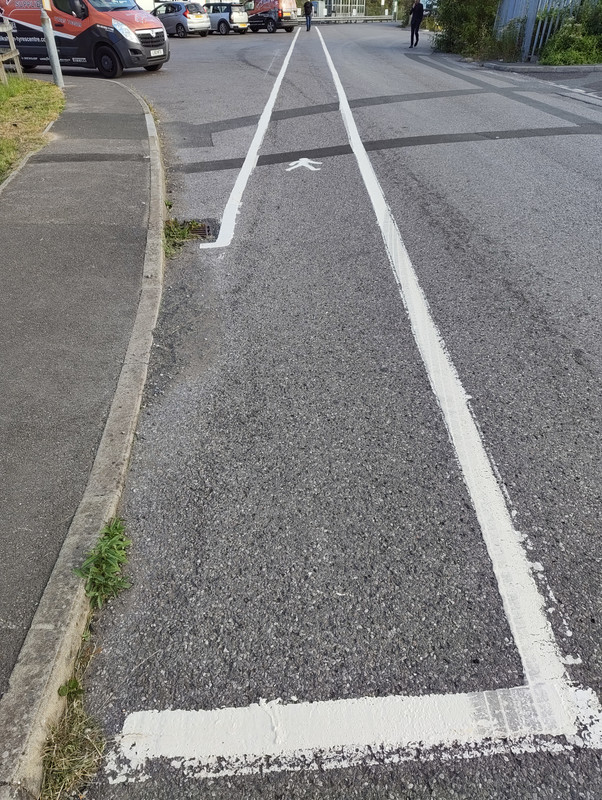
Yep - noticed it yesterday. Happy with that; it shows a care for and acknowledgment of the station by Wiltshire Council. I'm stopping one short of saying "delighted" - the request for the refresh came from MTUG via the Town Council and LHFIG (local highway and Infrastructure group) and requested coloured infill between the white lines to make the route even clearer between parked cars, as you can see at other stations.
| Re: Melksham station - facilities, services, improvements and incidents - merged posts In "TransWilts line - Swindon, Chippenham, Melksham, Trowbridge, Westbury, Salisbury" [376990/20082/18] Posted by JohnM at 09:16, 13th July 2026 | |
Not sure when it was done but I noticed this morning that the white lines protecting pedestrians walking to the station across the Melksham Tyres forecourt have been repainted - they were getting pretty shabby.
| Re: Nationalised operation maybe - but who OWNS the trains? In "Across the West" [376989/32220/26] Posted by grahame at 08:43, 13th July 2026 Already liked by PrestburyRoad, Mark A, Witham Bobby, 1st fan | |
Trying to work out a story ... distilled from https://weownit.org.uk/who-owns-our/railways
Porterbrook, Eversholt and Angel trains are the three main ROSCOs (Rolling Stock Operating Companies) that were formed in the UK following the privatisation of British Rail in 1994. They own and lease trains to passenger rail and freight companies.
Porterbrook is 30% owned by a Canadian pension fund, 30% by Allianz, a UK insurance firm, 30% owned by asset management firms and 10% owned by EDF which is owned by the French state.
Eversholt is ultimately owned by CK Hutchison Holdings Limited, a Hong Kong infrastructure company set up by billionaire Li Ka Shing, and now 25% owned by New York private equity firm KKR.
Angel Trains is 64% owned by Canadian pension fund the Public Sector Pension Investment Board (PSP), and 10% owned by Arjun Infrastructure Partners, a London-based asset management firm.
Porterbrook is 30% owned by a Canadian pension fund, 30% by Allianz, a UK insurance firm, 30% owned by asset management firms and 10% owned by EDF which is owned by the French state.
Eversholt is ultimately owned by CK Hutchison Holdings Limited, a Hong Kong infrastructure company set up by billionaire Li Ka Shing, and now 25% owned by New York private equity firm KKR.
Angel Trains is 64% owned by Canadian pension fund the Public Sector Pension Investment Board (PSP), and 10% owned by Arjun Infrastructure Partners, a London-based asset management firm.
30 years is a long time in business. My understanding is / was that the RoSCos initially took over a limited supply of trains that had limited capital value, but excellent rental value as they were hired to the Train Operating companies, resulting in excellent profits for the three companies who were under different ownership than that are today. With the growth of rail passenger numbers, the shortage of trains became even more of an issue and there were further profits to be made by hiring out old stock to the highest bidder. The success, if you like, of the franchised train operations in upping passenger numbers lead to a distorted market in train leasing.
30 years is a long time. And whilst quite a few of the original trains that were sold (? how much was paid) to the RoSCos at privatisation are still with us - in our area, classes 150, 158, 165 and 166 - others such as the class 175 ("The fleet is owned by Angel Trains, who has leased the fleet to various train operators" according to WikiPedia) and class 800 and 802 are owned by Hitachi who built them, and who lease them to the train operators. Classes such as 142 and 143 and HSTs (125, 43) which we have seen in the South West were withdrawn end-of-life; class 153 have gone from our area too though a few run on elsewhere in the dusk of their days. And I have no idea how much profit is going to the now-owners based on the original privatisation, nor what their profit margins are on newer stock especially once maintenance costs are taken into account.
Names such as HSBC Rail crop up; they came in as part of the natural development of the market economy of a for-profit setup, with takeovers, buyouts and failures being part of the mix. Such a setup may be excellent in terms of a many-supplier competitive market where one company take pick up business from another as they wither and as they blossom, but it's not, perhaps, a natural model in a market or industry which is monopolistic or close to it in nature. Further more, the little fish tend to be swallowed by the bigger ones and what started out as competitive intent became monopolies.
At Swindon, 25 to 30 years ago, you could catch passenger trains from TOCs Wales and West, Virgin, Thames Trains, and Great Western. Great Western was taken over by First. So then was Thames Trains. Wales and West became Wessex, which was combined with Thames Trains and Great Western as part of the Greater Western franchise that started on 1st April 2006, awarded to the First Group who have been running it since. Virgin, with their Swindon to Birmingham service were only on our tracks for a short time. The former Thames Train services from Bristol to Oxford were withdrawn (2004) because of "overcrowding on the tracks" but I say that in quotes because it looked like an excuse to move passengers onto less convenient, but more profitable operations still running on the same lines. A more recent parallel away from Swindon was the withdrawal of the Bristol - Salisbury - Waterloo through services that were well used, pushing a goodly proportion of passengers onto Bristol - Paddington services which means changes for many intermediate passengers, and more expensive (= more income for rail) journeys. Again, "Line Capacity" was an excuse, though I note the irony of the withdrawn trains being replaced by other trains - even using the same classes of rolling stock - subsidised by WECA and termination at Salisbury without even decent onward connections.
It should be noted that rail line capacity for passenger trains has changed over the years. In our area, the demise of the coal industry and closure of Didcot power station has resulted in a significant increase in train paths available from South Wales through the Severn Tunnel to Swindon and Didcot, but the growth of long distance freight from Southampton to the Midlands and north, and stone traffic from Somerset headed east and north east has to some extent counterbalanced that; it has certainly added pressure in some places like on the capacity-limited Trowbridge to Chippenham line. A part of this equation is the different characteristics of different train types - slow old coal wagons mixed with high speed trains lead to significant losses of capacity when one type followed the other. These days the performances differ but less dramaically.
Some Related topics
- Privatisation of Rail Infrastructure from British Railways to Railtrack and then the renationalisation of that just over 20 years ago into Network Rail.
- Passenger Train operation itself under franchises, turning into management contracts, and those contracts being terminated / not renewed as the whole comes together ready for Great British Railways (nationalised) operations
- Freight train ownership and operation which is largely privatised and in my understanding will remain so
- Properties and concessions at stations (you can pay more for a coffee than for a ticket)
| Re: Road markings and signs - various errors causing confusion, mirth and some concerns - merged pos In "The Wider Picture in the United Kingdom" [376988/12302/51] Posted by Bob_Blakey at 08:10, 13th July 2026 | |
My experience of roadkill whilst out cycling varies depending on the location; within the urban Exeter area the vast majority of victims are gulls - I don't regard this as a problem - and it is not uncommon to see two corpses together presumably because the gulls were concentrating on fighting over their share of whatever foodstuff was on offer rather than the vehicles heading in their direction.
On the road route (not the Exe Estuary Trail) between Exeter & Dawlish the majority of victims are grey squirrels, in East Devon it appears that the badger population is being progressively culled, and the occasional deceased rabbit or fox pops up in all areas.
Perhaps there should be national reporting so we can learn to what extent our wildlife is being decimated.
| Re: Swindon <-> Westbury service updates and amendments, ongoing discussion - 2026 In "TransWilts line - Swindon, Chippenham, Melksham, Trowbridge, Westbury, Salisbury" [376987/31359/18] Posted by JohnM at 07:51, 13th July 2026 | |
Then the 6:35 Salisbury Worcester developed a fault, so the 7:21 Melksham became 7:34.
Should have been ok to connect with the 7:47 Bristol (from Oxford) service at Chippenham, but then we had to wait for the late running Oxford service to pass us while we parked on the wrong side of the main line after leaving the single track.
So now it's another wait, for the 8:09 Bristol. What should have been arrival at Temple Meads at 7:28 is now 8:36, barring further delays...
| Re: Swindon <-> Westbury service updates and amendments, ongoing discussion - 2026 In "TransWilts line - Swindon, Chippenham, Melksham, Trowbridge, Westbury, Salisbury" [376986/31359/18] Posted by TaplowGreen at 05:28, 13th July 2026 Already liked by JohnM | |
05:11 Gloucester to Southampton Central due 08:10
05:11 Gloucester to Southampton Central due 08:10 will be diverted between Gloucester and Trowbridge.
It will no longer call at Stonehouse, Stroud, Kemble, Swindon, Chippenham and Melksham but will call additionally at Bristol Parkway.
It will be delayed due to the diversion and is expected to be 3 minutes late.
This is due to a fire next to the track.
| Re: Nationalised operation maybe - but who OWNS the trains? In "Across the West" [376985/32220/26] Posted by Chris from Nailsea at 00:21, 13th July 2026 | |
I did say it was in the backermost recesses of my (apparently failing) memory.
| Re: Nationalised operation maybe - but who OWNS the trains? In "Across the West" [376984/32220/26] Posted by stuving at 00:09, 13th July 2026 | |
From the backermost recesses of my memory, I seem to recall that HSBC owned some of them.
Or is that hogwash, II ?
Or is that hogwash, II ?
History, more like. Eversholt (one of the original ROSCOs from thew BR break-up) was owned by Midland Bank, which became part of HSBC, and was then sold off by them in 2010.
| Re: Nationalised operation maybe - but who OWNS the trains? In "Across the West" [376983/32220/26] Posted by Chris from Nailsea at 22:11, 12th July 2026 Already liked by IndustryInsider | |
From the backermost recesses of my memory, I seem to recall that HSBC owned some of them.
Or is that hogwash, II ?
| Re: Nationalised operation maybe - but who OWNS the trains? In "Across the West" [376982/32220/26] Posted by John D at 21:56, 12th July 2026 Already liked by IndustryInsider | |
First own some IETs and I'm sure their serial numbers can be found somewhere on this forum
Hitachi own the remainder
Hitachi own the remainder
Are you sure about that?
I think some of the 36 class 802s are owned by Eversholt (but were ordered by First Group, rather than by DfT), Hitachi have a maintenance contract, GWR lease them from Eversholt
I think the class 800s are owned by Agility Trains, which is part owned by Hitachi, part owned by AXA and part by GLIL Infrastructure (an investment by consortium of pension funds)
EDIT It is Agility Trains West Ltd, which is wholly owned subsidiary of Agility Trains (MidCo) Ltd, which in turn is wholly owned subsidiary of Agility Trains West (Holdings) Ltd, which in turn is subsidiary of joint venture where Hitachi hold 25%. (complicated, but presumably works better to minimise tax etc)
| Re: Barbeques, on the railway and elsewhere - ongoing discussion In "The Lighter Side" [376981/32069/30] Posted by Oxonhutch at 21:44, 12th July 2026 Already liked by Chris from Nailsea, GBM | |
| Re: Nationalised operation maybe - but who OWNS the trains? In "Across the West" [376980/32220/26] Posted by IndustryInsider at 21:36, 12th July 2026 | |
First own some IETs and I'm sure their serial numbers can be found somewhere on this forum
Hitachi own the remainder
Hitachi own the remainder
Are you sure about that?
