







| Germany - rail services, ticketing and incidents (merged posts) Posted by Chris from Nailsea at 21:37, 30th March 2009 |     |
The head of Germany's railway company, Deutsche Bahn, is stepping down after the company admitted spying on thousands of its employees. Chief executive Hartmut Mehdorn is quitting after running the firm for nearly a decade.
The firm admitted that it conducted a surveillance operation on staff, intended to tackle corruption. Mr Mehdorn said he had not been aware of the spying but expressed regret over what had happened.
Deutsche Bahn, the country's biggest public company, has previously confirmed it employed investigators from a detective agency in Berlin to carry out covert surveillance operations on its employees. It has also admitted monitoring staff emails to check whether they were being critical of the company's policies.
The firm admitted that it conducted a surveillance operation on staff, intended to tackle corruption. Mr Mehdorn said he had not been aware of the spying but expressed regret over what had happened.
Deutsche Bahn, the country's biggest public company, has previously confirmed it employed investigators from a detective agency in Berlin to carry out covert surveillance operations on its employees. It has also admitted monitoring staff emails to check whether they were being critical of the company's policies.
See http://news.bbc.co.uk/1/hi/business/7971969.stm
| Germany - rail services, ticketing and incidents (merged posts) Posted by Chris from Nailsea at 21:50, 10th November 2009 | |
From the BBC:
Germany and Hannover 96 goalkeeper Robert Enke has died after being hit by a train in an apparent suicide, police have confirmed. Enke, 32, was fatally injured at a level crossing northwest of Hannover.
The German football federation (DFB) said in a statement: "The German team has learned of the death of Robert Enke with great shock.
Germany coach Joachim Loew and manager Oliver Bierhoff added: "We are all shocked, we are speechless."
Enke's daughter Lara died in 2006 of a rare heart condition when she was just two. He leaves behind his wife, Teresa, and an eight-month-old daughter the couple had adopted in May.
German police released a statement saying: "The victim is apparently national team goalkeeper Robert Enke from Hannover 96. The first police indications are that it was a suicide."
Enke was struck by a regional train travelling between Norddeich and Hannover at a railway crossing in Neustadt am Rubenberge and died at the scene.
He played eight times for Germany and also for clubs Jena, Borussia Moenchengladbach, Benfica, Barcelona, Fenerbahce and Tenerife, before returning to the Bundesliga with Hannover in 2004.
Enke made his international debut aged 31 and became Germany's number one keeper after Jens Lehmann retired from internationals at the end of Euro 2008.
He had missed Germany's last four matches with a virus but returned for his club at the weekend.
Loew had indicated that Enke was in pole position for the number one jersey at next year's World Cup finals in South Africa.
Dr Theo Zwanziger, president of the DFB, said that the football community in Germany "are deeply distressed and in mourning", adding: "All our sympathy goes to the wife of Robert Enke and his family."
The Germany squad is currently in Bonn ahead of a friendly against Chile on Saturday, but Enke had been left out of the squad having only just returned to action for his club.
Fans were flocking to Hannover's Niedersachsen Stadion on Tuesday night to lay flowers and light candles for the captain of their club.
A news conference has been scheduled for 1230 GMT on Wednesday.
The German football federation (DFB) said in a statement: "The German team has learned of the death of Robert Enke with great shock.
Germany coach Joachim Loew and manager Oliver Bierhoff added: "We are all shocked, we are speechless."
Enke's daughter Lara died in 2006 of a rare heart condition when she was just two. He leaves behind his wife, Teresa, and an eight-month-old daughter the couple had adopted in May.
German police released a statement saying: "The victim is apparently national team goalkeeper Robert Enke from Hannover 96. The first police indications are that it was a suicide."
Enke was struck by a regional train travelling between Norddeich and Hannover at a railway crossing in Neustadt am Rubenberge and died at the scene.
He played eight times for Germany and also for clubs Jena, Borussia Moenchengladbach, Benfica, Barcelona, Fenerbahce and Tenerife, before returning to the Bundesliga with Hannover in 2004.
Enke made his international debut aged 31 and became Germany's number one keeper after Jens Lehmann retired from internationals at the end of Euro 2008.
He had missed Germany's last four matches with a virus but returned for his club at the weekend.
Loew had indicated that Enke was in pole position for the number one jersey at next year's World Cup finals in South Africa.
Dr Theo Zwanziger, president of the DFB, said that the football community in Germany "are deeply distressed and in mourning", adding: "All our sympathy goes to the wife of Robert Enke and his family."
The Germany squad is currently in Bonn ahead of a friendly against Chile on Saturday, but Enke had been left out of the squad having only just returned to action for his club.
Fans were flocking to Hannover's Niedersachsen Stadion on Tuesday night to lay flowers and light candles for the captain of their club.
A news conference has been scheduled for 1230 GMT on Wednesday.
| Germany - rail services, ticketing and incidents (merged posts) Posted by Chris from Nailsea at 10:36, 23rd October 2010 | |
Video report, from the BBC:
A dispute over the redevelopment of a station in Germany has moved from a local planning row to a national issue and a major political headache for Chancellor Angela Merkel.
The project to develop Stuttgart's terminal has attracted thousands of demonstrators each week, but local protests are now shifting to a wider movement against the government, in the heartland of the ruling party.
The project to develop Stuttgart's terminal has attracted thousands of demonstrators each week, but local protests are now shifting to a wider movement against the government, in the heartland of the ruling party.
| Re: Stuttgart station dispute goes national in Germany Posted by eightf48544 at 11:52, 23rd October 2010 | |
Having been in Stuttgart in September an seen the protests I can partly see their point, it will cause ten years worth of disruption to the station and the adjacent parkland. However when finished it will release a huge area of land North of the exisiting station which comprises the exisiting station approaches. Which can be redeveloped as housing/business parks. Stuttgart is a particulay cramped city hemmed in on three sides by quite high hills.
It is an interesting operating dilemna for DB in that there is now a conflict between the HBF concept (single large station for each city) and the high speed ICE services. This especialy so when the Hbf is a terminal staion which many are. Stuttgart being a case in point. All ICE's from the Rhine/Frankfurt to Munich/Austria have to reverse in Stuttgart thus adding at least 10 minutes or so to the journey times.
By building a through station linking directly to the NBS (Neu Bau Strasse) High speed lines considerable savings can be made to journey times on trains passing through Stuttgart. However these shortened journey tiems are of no benefit to Stuttgart passengers as their journeys will take much the same time whther they get on in the exisitng station or teh new underground through station.
There was an article in October's editon of Todays Railways Europe outlining the whole scheme
| Re: Stuttgart station dispute goes national in Germany Posted by willc at 12:55, 23rd October 2010 | |
NBS means Neubaustrecke (new build route). I'd be a bit worried about them running ICEs on streets (Strasse)
| Germany - rail services, ticketing and incidents (merged posts) Posted by JayMac at 05:06, 30th January 2011 | |
From the BBC:
At least 10 people are reported to have died in a train crash in eastern Germany.
A local passenger train and a goods train collided head-on in the state of Saxony-Anhalt late on Saturday, near the city of Magdeburg.
The passenger train, the HarzElbeExpress, was travelling on a single track section between Magdeburg and Halberstadt.
The cause of the crash, which left 33 injured, is unclear.
Several carriages were derailed after the collision near the village of Hordorf at about 2230 (2130 GMT).
"Rescue operations are still ongoing. The death toll may well rise further," said regional police spokesman Frank Kuessner said.
More than 150 firemen, police and rescue workers were at the scene, AFP reported.
The passenger train "was the last train of the evening out of Magdeburg" on the line - a single track on which overnight engineering work was scheduled.
A spokesman for Veolia, the company which runs the HarzElbeExpress service, said that the train had a capacity of about 100 people. About 45 people were on board at the time of the crash.
A local passenger train and a goods train collided head-on in the state of Saxony-Anhalt late on Saturday, near the city of Magdeburg.
The passenger train, the HarzElbeExpress, was travelling on a single track section between Magdeburg and Halberstadt.
The cause of the crash, which left 33 injured, is unclear.
Several carriages were derailed after the collision near the village of Hordorf at about 2230 (2130 GMT).
"Rescue operations are still ongoing. The death toll may well rise further," said regional police spokesman Frank Kuessner said.
More than 150 firemen, police and rescue workers were at the scene, AFP reported.
The passenger train "was the last train of the evening out of Magdeburg" on the line - a single track on which overnight engineering work was scheduled.
A spokesman for Veolia, the company which runs the HarzElbeExpress service, said that the train had a capacity of about 100 people. About 45 people were on board at the time of the crash.
Edit to update link - Graham
| Re: German train crash near Magdeburg leaves 10 dead. (BBC News 30/01/2011) Posted by eightf48544 at 10:03, 30th January 2011 | |
Deepest sympathy.
I've travelled on that line on several occasions over the years from 1996 and seen the steady upgrade of the old DDR railways.
In 1996 it was still the big Russian 232s Ludmillars , then the DDR's answer to the V200 and WR Warships the 219 U-boat, and then then ex DB 218's rabbits and now modern units. The operator has also been privatised with Veolia although branded a HEX.
| Re: German train crash near Magdeburg leaves 10 dead. (BBC News 30/01/2011) Posted by JayMac at 04:35, 31st January 2011 | |
A little more information on the collision from Deutsche Welle:
http://www.dw-world.de/dw/article/0,,14804340,00.html?maca=en-rss-en-ger-1023-rdf
| Germany - rail services, ticketing and incidents (merged posts) Posted by JayMac at 16:59, 17th May 2015 | |
From the BBC:
At least two people were killed and 20 injured in western Germany when a passenger train hit a tractor-trailer on a level crossing, police say.
The accident happened near the town of Ibbenbueren when the train, from Osnabrueck, struck the vehicle which was carrying manure, officials added.
Three of those injured were said to be in a serious condition.
Initial reports said the vehicle got stuck while trying to cross the railway line, police said.
Police spokesman Jochen Laschke said the incident happened in a rural area close to Ibbenbueren which is about 23km (15 miles) west of Osnabrueck.
"We got an emergency call at 11:31 (09:32 GMT) and rescue team, fire fighters and psychologists from all over the region were activated to help."
"The train was very crowded," he said.
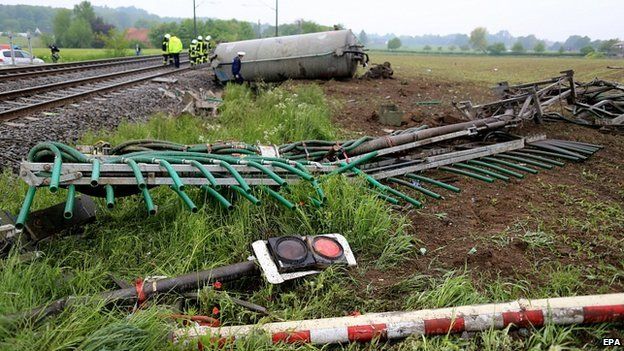
Mr Laschke said that after hitting the tractor-trailer, the train came to a halt about 200m (650ft) down the track. He added that the driver of the tractor had not been injured.
Footage from the scene showed parts of the tractor on one side of the tracks and a tank that had been carrying the manure on the other side.
The front of the train was badly damaged with windows and metal parts torn away.
German media said the train, which had been heading to Ibbenbueren, was operated by private rail company Westfalenbahn.
The accident happened near the town of Ibbenbueren when the train, from Osnabrueck, struck the vehicle which was carrying manure, officials added.
Three of those injured were said to be in a serious condition.
Initial reports said the vehicle got stuck while trying to cross the railway line, police said.
Police spokesman Jochen Laschke said the incident happened in a rural area close to Ibbenbueren which is about 23km (15 miles) west of Osnabrueck.
"We got an emergency call at 11:31 (09:32 GMT) and rescue team, fire fighters and psychologists from all over the region were activated to help."
Parts of the farm vehicle were strewn along the side of the track
"The train was very crowded," he said.
Mr Laschke said that after hitting the tractor-trailer, the train came to a halt about 200m (650ft) down the track. He added that the driver of the tractor had not been injured.
Footage from the scene showed parts of the tractor on one side of the tracks and a tank that had been carrying the manure on the other side.
The front of the train was badly damaged with windows and metal parts torn away.
German media said the train, which had been heading to Ibbenbueren, was operated by private rail company Westfalenbahn.
A video news report accompanies the article. http://www.bbc.co.uk/news/world-europe-32764373
| Germany - rail services, ticketing and incidents (merged posts) Posted by TeaStew at 16:38, 19th November 2015 | |
I stumbled across this and do not recall it being posted here before, some may find it a pleasant distraction. Seems to be a live feed of various transport in Berlin and although I do not really know the city it is mesmerising.
http://fahrinfo.vbb.de/bin/help.exe/dn?L=vs_mobilitymap&&tpl=fullmap&tabApp=show&initialX=13354846&initialY=52478287&initialZ=3936&
| Re: Berlin transport feed Posted by patch38 at 16:48, 19th November 2015 | |
That's fantastic - it's like a ground-based version of Flightradar24!
| Re: Berlin transport feed Posted by chrisr_75 at 16:54, 19th November 2015 | |
That reminds me of something that used to be on an obscure analogue Sky channel late at night (no, not that...). They used to just show continuous footage recorded from the front of trams across various European cities, mostly German I think. That also was surprisingly addictive to watch!
We're almost at the point of having something like this with London buses real time arrivals - the data just needs to be plotted out on a map. It would be quite useful/interesting for other forms of public transport.
| Re: Berlin transport feed Posted by bobm at 17:11, 19th November 2015 | |
There is this one for the UK - http://traintimes.org.uk/map/#bhm
Not quite the same - but if you chose a station it will show you where trains due to call are at the current time.
| Re: Berlin transport feed Posted by Electric train at 17:56, 19th November 2015 | |
Berlin, I had a great time a month ago using the U-bahn and S-bahn to get around
| Re: Berlin transport feed Posted by Surrey 455 at 22:07, 19th November 2015 | |
They have a mobile app that lets you use your phone as your tageskarte (1day travelcard). I eventually decided not to use it because the terms and conditions state that you must carry recognised photo ID. I didn't have my driving licence and wasn't prepared to keep my passport on me either. A shame because the Berlin (and every other German city I have been to) S+U bahn ticket machines only take cash or German cards.
| Germany - rail services, ticketing and incidents (merged posts) Posted by Chris from Nailsea at 23:48, 18th July 2016 | |
From the BBC:
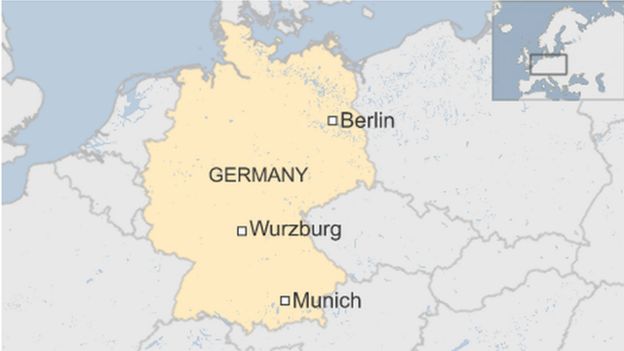
Germany axe attack: Assault on train in Wuerzburg
A man armed with an axe injured four people on a train in southern Germany before being shot dead by police, officials say.
Three people were seriously hurt and one suffered minor injuries in the attack in Wuerzburg, police said.
Initial reports said up to 20 people had been injured but it was later revealed that at least 14 had been treated for shock.
The identity of the attacker or the motive is not yet clear.
A Bavarian official quoted by German media said that the attacker was a 17-year-old Afghan refugee, but this was not confirmed.
A police spokesman at the scene said (in German) that the attacker had been shot dead while trying to flee.
The train line between Wurzburg-Heidingsfeld and Ochsenfurt has been closed.
A man armed with an axe injured four people on a train in southern Germany before being shot dead by police, officials say.
Three people were seriously hurt and one suffered minor injuries in the attack in Wuerzburg, police said.
Initial reports said up to 20 people had been injured but it was later revealed that at least 14 had been treated for shock.
The identity of the attacker or the motive is not yet clear.
A Bavarian official quoted by German media said that the attacker was a 17-year-old Afghan refugee, but this was not confirmed.
A police spokesman at the scene said (in German) that the attacker had been shot dead while trying to flee.
The train line between Wurzburg-Heidingsfeld and Ochsenfurt has been closed.
| Re: Germany axe attack: Assault on train in Wuerzburg Posted by ChrisB at 09:41, 19th July 2016 | |
Police reported to have found an IS flag at his home.
| Re: Germany axe attack: Assault on train in Wuerzburg Posted by broadgage at 11:30, 19th July 2016 | |
Police reported to have found an IS flag at his home.
And it is also now reported that he shouted "god is great" in Arabic before the attack, and that Islamic state have claimed the attack.
No doubt the usual exhortations to "be vigilant" on UK public transport will follow, though I am not certain the vigilance would help much in such cases.
| Re: Germany axe attack: Assault on train in Wuerzburg Posted by Chris from Nailsea at 22:07, 22nd July 2016 | |
News of a further incident in Germany, from the BBC:
Munich shooting: Police say eight dead as manhunt continues
German police are engaged in a huge anti-terror manhunt in the city of Munich after eight people died in a shopping mall shooting.
Police confirmed eight deaths at the Olympia mall and several wounded.
The attackers are still on the run. Witnesses said they had seen three with guns. Police urged people to avoid public places.
Shop workers are still in the mall, in the north-western Moosach district. Public transport has been suspended.
Police are now describing it as "an acute terror situation". They say the first reports of a shooting in Hanauer Street came in just before 18:00 (16:00 GMT).
The Bavarian capital's central railway station has been evacuated.
People stranded by the emergency and unable to get home are being offered shelter by locals. The initiative was launched with the Twitter hashtag #Offenetür (open door).
Police helicopters are flying over the city and special forces are involved in the massive police deployment.
Bavarian public radio reports that an elite border security unit, GSG9, is heading for Munich with several helicopters.
Bavarian Prime Minister Horst Seehofer is holding a crisis meeting with security advisers. The German Interior Minister, Thomas de Maiziere has cut short his holiday.
Meanwhile the neighbouring Czech Republic is boosting its border security.
German security forces have been on alert since a teenage migrant stabbed and injured five people on a train in Bavaria on Monday, in an attack claimed by so-called Islamic State.
The authorities had warned of the danger of further incidents.
More details have begun emerging about events at the shopping centre.
Local resident Dominic Faust described how people entered the mall screaming. "Those people told us that there was a shooting outside and so the security closed the door of this mall and asked everybody to go upstairs to the fifth floor," he said.
A man working at a petrol station in Munich earlier told the BBC: "We see just ambulances and firemen and police but all this area is evacuated, all the streets. Now [there] are no cars just on the side of the streets. All of the streets are blocked. I see that the people are scared. Everybody are running around."
Munich police said they did not know where "the perpetrators" were. "Look after yourselves and avoid public places".
Munich police also urged people to help their operation by avoiding speculation and to desist from using photos or video of their deployments online.
German police are engaged in a huge anti-terror manhunt in the city of Munich after eight people died in a shopping mall shooting.
Police confirmed eight deaths at the Olympia mall and several wounded.
The attackers are still on the run. Witnesses said they had seen three with guns. Police urged people to avoid public places.
Shop workers are still in the mall, in the north-western Moosach district. Public transport has been suspended.
Police are now describing it as "an acute terror situation". They say the first reports of a shooting in Hanauer Street came in just before 18:00 (16:00 GMT).
The Bavarian capital's central railway station has been evacuated.
People stranded by the emergency and unable to get home are being offered shelter by locals. The initiative was launched with the Twitter hashtag #Offenetür (open door).
Police helicopters are flying over the city and special forces are involved in the massive police deployment.
Bavarian public radio reports that an elite border security unit, GSG9, is heading for Munich with several helicopters.
Bavarian Prime Minister Horst Seehofer is holding a crisis meeting with security advisers. The German Interior Minister, Thomas de Maiziere has cut short his holiday.
Meanwhile the neighbouring Czech Republic is boosting its border security.
German security forces have been on alert since a teenage migrant stabbed and injured five people on a train in Bavaria on Monday, in an attack claimed by so-called Islamic State.
The authorities had warned of the danger of further incidents.
More details have begun emerging about events at the shopping centre.
Local resident Dominic Faust described how people entered the mall screaming. "Those people told us that there was a shooting outside and so the security closed the door of this mall and asked everybody to go upstairs to the fifth floor," he said.
A man working at a petrol station in Munich earlier told the BBC: "We see just ambulances and firemen and police but all this area is evacuated, all the streets. Now [there] are no cars just on the side of the streets. All of the streets are blocked. I see that the people are scared. Everybody are running around."
Munich police said they did not know where "the perpetrators" were. "Look after yourselves and avoid public places".
Munich police also urged people to help their operation by avoiding speculation and to desist from using photos or video of their deployments online.
| Re: Germany axe attack: Assault on train in Wuerzburg Posted by ChrisB at 05:46, 23rd July 2016 | |
Now 9 dead, amd gunman committed suicide. 18yo German/Iranian dual-nationality.
| Germany - rail services, ticketing and incidents (merged posts) Posted by broadgage at 20:45, 5th December 2017 | |
Early reports suggest a collision between a passenger train and a freight train.
Up to 50 persons injured, no word on fatalities, hopefully there are no lives lost.
Near Dusseldorf.
http://www.bbc.co.uk/news/world-europe-42246087
| Re: "dozens injured" in German train crash, 05/12/2017. Posted by broadgage at 20:52, 5th December 2017 | |
Slightly later reports put the number of injured at only five, compared to earlier reports of "dozens" or "about 50"
Pictures on social media appeared to show a number of "walking wounded" receiving first aid treatment for cuts.
| Re: "dozens injured" in German train crash, 05/12/2017. Posted by 4064ReadingAbbey at 20:35, 8th December 2017 | |
A report from the German news magazine Der Spiegel can be found http://www.spiegel.de/panorama/zugunglueck-in-meerbusch-a-1181943.html, in German. (I'm in Germany at the moment...!)
Google Translate ist your friend...!
| Re: "dozens injured" in German train crash, 05/12/2017. Posted by stuving at 22:07, 8th December 2017 | |
Or, for something easier (still dated Wednesday), Deutsche Welle:
Germany opens inquiry after train collision injures dozens
Authorities have said it is too early to speculate what caused the collision between a freight train and a passenger train near Düsseldorf. The driver of the train was praised, however, for preventing a worse crash.
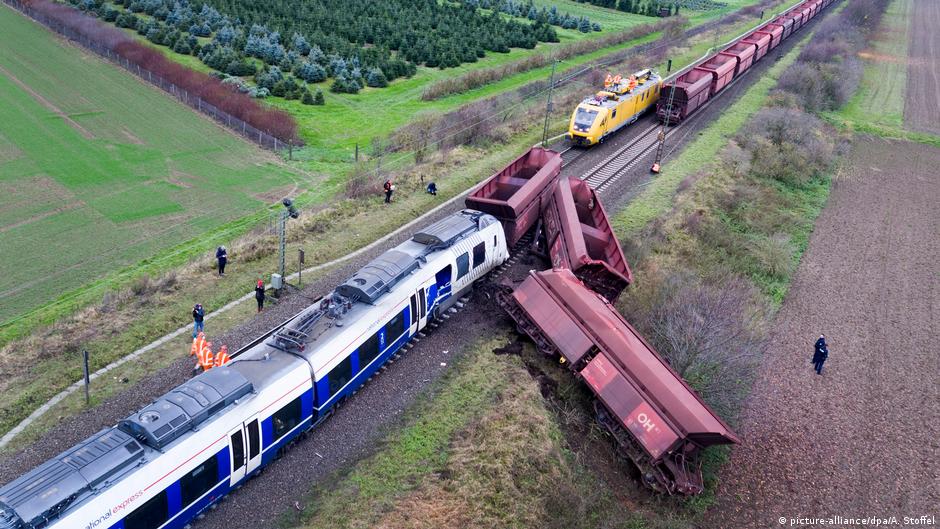 (picture-alliance/dpa/A. Stoffel)
German authorities were investigating the cause of a train accident on Wednesday after dozens of people were injured in a collision near the city of Düsseldorf.
Marcel Winter, a spokesman for the British-owned National Express railway, said it remained unclear why the passenger train traveling from Cologne to Krefeld struck a Deutsche Bahn cargo train on its way to Rotterdam on Tuesday night.
Clean up crews were still on the scene on Wednesday afternoon, and Winter added that the line would remain closed until the debris was cleared away and the electrical overhead wires repaired. Repair work to the tracks is expected to take at least a few days.
The driver was praised for swiftly applying the emergency brake and slowing the passenger train
It emerged on Wednesday that the driver of the passenger train had slammed on the emergency brake as soon as he saw an obstacle on the tracks, avoiding a much more serious collision.
"We were very lucky," said Winter. "It could have been much worse."
Initial reports indicated that 50 people had been injured in the incident, but that number was later revised. Police said that nine of the 41 passengers wounded were seriously hurt, while the other 105 on the train were able to walk away unscathed.
Later on Wednesday, an expert from Germany's Federal Railway Accident Investigation Board (BEU) said that "the passenger train should not have been allowed to drive on this particular track."
BEU spokesman Gerd Münnich said that the cargo train was standing still and waiting for a signal to enter the station at Meerbusch when the collision occurred. Subsequent trains are not allowed to drive on to the same tracks when the train in front of them is stationary.
Passengers remained calm, says witness
The crash occurred around 7:30 pm local time (1830 UTC) in the small town of Meerbusch, in Germany's most populous state of North-Rhine Westphalia (NRW). The front car of the train was heavily damaged, but the rest of the train was largely unaffected.
The fire department was able to rescue the last of the passengers at around 9:15 pm, after initially being unable to reach the site due to damaged high-voltage wires.
Passenger Lukas Kehler, 19, told public broadcaster WDR that the crash had been loud and frightening, but that all on board had remained calm.
"There was no sense of panic," he said.
Images showed that there was moderate damage to the passenger train's front carriage, while the others appeared largely unaffected. Some of the cargo train carriages were thrown off the rails, however, as a result of the collision.
Most train services in Germany are run by the partly-state owned Deutsche Bahn, but National Express has been operating some routes in NRW since 2015.
Authorities have said it is too early to speculate what caused the collision between a freight train and a passenger train near Düsseldorf. The driver of the train was praised, however, for preventing a worse crash.
(picture-alliance/dpa/A. Stoffel)German authorities were investigating the cause of a train accident on Wednesday after dozens of people were injured in a collision near the city of Düsseldorf.
Marcel Winter, a spokesman for the British-owned National Express railway, said it remained unclear why the passenger train traveling from Cologne to Krefeld struck a Deutsche Bahn cargo train on its way to Rotterdam on Tuesday night.
Clean up crews were still on the scene on Wednesday afternoon, and Winter added that the line would remain closed until the debris was cleared away and the electrical overhead wires repaired. Repair work to the tracks is expected to take at least a few days.
The driver was praised for swiftly applying the emergency brake and slowing the passenger train
It emerged on Wednesday that the driver of the passenger train had slammed on the emergency brake as soon as he saw an obstacle on the tracks, avoiding a much more serious collision.
"We were very lucky," said Winter. "It could have been much worse."
Initial reports indicated that 50 people had been injured in the incident, but that number was later revised. Police said that nine of the 41 passengers wounded were seriously hurt, while the other 105 on the train were able to walk away unscathed.
Later on Wednesday, an expert from Germany's Federal Railway Accident Investigation Board (BEU) said that "the passenger train should not have been allowed to drive on this particular track."
BEU spokesman Gerd Münnich said that the cargo train was standing still and waiting for a signal to enter the station at Meerbusch when the collision occurred. Subsequent trains are not allowed to drive on to the same tracks when the train in front of them is stationary.
Passengers remained calm, says witness
The crash occurred around 7:30 pm local time (1830 UTC) in the small town of Meerbusch, in Germany's most populous state of North-Rhine Westphalia (NRW). The front car of the train was heavily damaged, but the rest of the train was largely unaffected.
The fire department was able to rescue the last of the passengers at around 9:15 pm, after initially being unable to reach the site due to damaged high-voltage wires.
Passenger Lukas Kehler, 19, told public broadcaster WDR that the crash had been loud and frightening, but that all on board had remained calm.
"There was no sense of panic," he said.
Images showed that there was moderate damage to the passenger train's front carriage, while the others appeared largely unaffected. Some of the cargo train carriages were thrown off the rails, however, as a result of the collision.
Most train services in Germany are run by the partly-state owned Deutsche Bahn, but National Express has been operating some routes in NRW since 2015.
I'm puzzled quite how those goods wagons got pushed off the track into that position.
| Re: "dozens injured" in German train crash, 05/12/2017. Posted by grahame at 22:15, 8th December 2017 | |
I'm puzzled quite how those goods wagons got pushed off the track into that position.
It does look odd. I would suggest the passenger train rear-ended the freight it happened that the rear vehicle was lifted by the nose and fell right, dragging the next one until couplings broke and 2nd got pushed too. And I suspect the rest of the freight had been moved forward before the picture was taken, the yellow thing being some sort of engineering or emergency vehicle also brought in later.
| Re: "dozens injured" in German train crash, 05/12/2017. Posted by stuving at 22:51, 8th December 2017 | |
I'm puzzled quite how those goods wagons got pushed off the track into that position.
It does look odd. I would suggest the passenger train rear-ended the freight it happened that the rear vehicle was lifted by the nose and fell right, dragging the next one until couplings broke and 2nd got pushed too. And I suspect the rest of the freight had been moved forward before the picture was taken, the yellow thing being some sort of engineering or emergency vehicle also brought in later.
It must be along those lines. In fact, as those wagons are empty, the two end ones may have steepled upwards and fallen sideways together, while the train ran underneath to the next. The picture of the leading carriage (not copied) does show that it's taken a big downward push on its nose, enough to bend it in the middle.
| Re: "dozens injured" in German train crash, 05/12/2017. Posted by eightf48544 at 15:28, 9th December 2017 | |
The bend/crack in the driving coach looks even more severe in the BBC photo. Twitter/@FWMeerbusch
| Re: "dozens injured" in German train crash, 05/12/2017. Posted by Electric train at 16:30, 9th December 2017 | |
I'm puzzled quite how those goods wagons got pushed off the track into that position.
I think the passenger train was still traveling at quite a high speed when it hit the freight looking at the damage to the leading coach. The fact the freight was empty and the waggons deflected they way they did absorbed a lot of the energy, I feel if they had been loaded there would have been loss of life and far greater number of injured.
| Re: "dozens injured" in German train crash, 05/12/2017. Posted by broadgage at 16:40, 9th December 2017 | |
Regarding the derailed goods wagons, is it possible that these vehicles were ALREADY off the track due to some unrelated mishap, such as a defect in the track or the goods wagons.
The division of the goods train would apply the brakes and promptly stop the train.
The signalling system should of course protect the partially derailed and stopped goods train, it would appear that this did not work.
I doubt that a relatively lightweight passenger train could fling the goods wagons some distance into the field where they are situated.
I consider it POSSIBLE that the passenger train struck the goods wagon that was already derailed but more or less upright and in line, and that the two vehicles in the field may not have been involved.
EDIT TO ADD This now looks unlikely, see following post for details.
| Re: "dozens injured" in German train crash, 05/12/2017. Posted by stuving at 18:06, 9th December 2017 | |
Having looked a a few more reports, some more recent, the story is as follows (though much of this is really hearsay picked up by journalists, rather than official):
- The goods train had stopped at a signal, but had just started again when struck
- The passenger train had also stopped, but been told to move off again. Some reports have this as a verbal permission, not signalled.
- The last two goods wagons were thrown off the track. The tops of the bodies of some a pretty bent, so they must have been pushed well out of line.
- Here's a video of the damage, showing more detail - pause it when those words aren't in the way!
- Wagons don't have buffers any more, the end force will be borne by the coupling alone. These seem to have collapsed, not surprisingly (and perhaps intentionally). The ends of the chassis frames ought perhaps to hold them true, but it only needs one wagon to rise or slew a bit for that to collapse too, asymmetrically.
- There was a near miss not far away (at Gruiten bei Solingen) in similar circumstances in February - attributed to a signaller's error. That time an ICE just stopped before hitting another train.
| Germany - rail services, ticketing and incidents (merged posts) Posted by broadgage at 14:40, 15th October 2018 | |
It is not clear if this was targeting the railway, or if it is a random act of terrorism/criminality that merely happened to be at a station rather than some other public space.
https://www.bbc.co.uk/news/world-europe-45862091
Some reports state that shots have been fired.
| Re: Hostage taken at Cologne rail station. Posted by ChrisB at 14:45, 15th October 2018 | |
German police say they now have an armed assailant at Cologne's main railway station "under control" and the woman he took hostage is receiving medical treatment.
She had minor injuries from the incident but he is reported to have serious injuries.
There was a full evacuation of the station, one of Germany's biggest transport hubs.
Local media say the incident does not appear to have been terror-related.
Earlier there were unconfirmed reports of shots being fired.
Police quoted by the Koelner Stadt-Anzeiger daily said a couple were involved, and the man had argued with the woman in a McDonald's restaurant, before holding her in a pharmacy at the station.
Reports speak of at least one explosion during the incident.
Deutsche Bahn cancelled or delayed train services in Cologne during the standoff
She had minor injuries from the incident but he is reported to have serious injuries.
There was a full evacuation of the station, one of Germany's biggest transport hubs.
Local media say the incident does not appear to have been terror-related.
Earlier there were unconfirmed reports of shots being fired.
Police quoted by the Koelner Stadt-Anzeiger daily said a couple were involved, and the man had argued with the woman in a McDonald's restaurant, before holding her in a pharmacy at the station.
Reports speak of at least one explosion during the incident.
Deutsche Bahn cancelled or delayed train services in Cologne during the standoff
| Re: Hostage taken at Cologne rail station. Posted by broadgage at 14:45, 15th October 2018 | |
"hostage now safe" later reports state.
| Germany - rail services, ticketing and incidents (merged posts) Posted by eXPassenger at 15:11, 20th December 2018 | |
From the Guardian https://www.theguardian.com/world/2018/dec/20/trains-on-time-germans-deutsche-bahn-railway
Cancelled trains, lengthy delays, cracked bridges and wildcat strikes by disgruntled employees – a trail of chaos in recent months has caused Deutsche Bahn (DB) to become the butt of jokes and withering complaints.
Once the pride of the German state that owns it and the envy of much of the rest of the world, Germany’s national rail network is showing considerable signs of strain and decline amid accusations of chronic underinvestment in its infrastructure.
Transport watchers say the rail network is in danger of plunging to reliability levels familiar to British commuters but alien to Germans who for years took punctuality for granted.
Deutsche Bahn transports 2 billion customers a year and is the largest rail operator in Europe. At its peak, 95% of German trains ran on time, whereas at one point this year that figure slumped to just a third.
...
Germany’s Pro Rail Alliance, an amalgamation of non-profit NGOs and businesses, says 90% of Germans support its call for more investment. It argues that despite a big financial injection in recent years, Germany’s €69 per capita spending in rail infrastructure still lags far behind that of comparable countries such as Britain (€165) and Switzerland (€362).
Once the pride of the German state that owns it and the envy of much of the rest of the world, Germany’s national rail network is showing considerable signs of strain and decline amid accusations of chronic underinvestment in its infrastructure.
Transport watchers say the rail network is in danger of plunging to reliability levels familiar to British commuters but alien to Germans who for years took punctuality for granted.
Deutsche Bahn transports 2 billion customers a year and is the largest rail operator in Europe. At its peak, 95% of German trains ran on time, whereas at one point this year that figure slumped to just a third.
...
Germany’s Pro Rail Alliance, an amalgamation of non-profit NGOs and businesses, says 90% of Germans support its call for more investment. It argues that despite a big financial injection in recent years, Germany’s €69 per capita spending in rail infrastructure still lags far behind that of comparable countries such as Britain (€165) and Switzerland (€362).
I thought that the level of government investment was interesting.
| Re: German railways are not all they are made out to be Posted by TonyK at 17:24, 20th December 2018 | |
They can't really blame Brexit.
| Re: German railways are not all they are made out to be Posted by simonw at 08:29, 21st December 2018 | |
Is that total government investment in German Railways.
Last time I was in Germany I saw signs about German Rail Investment by Federal, State and City authorities (rail link from airport to city).
| Re: German railways are not all they are made out to be Posted by Noggin at 11:25, 21st December 2018 | |
I believe that DB only runs something like 60% of German rail services.
| Re: German railways are not all they are made out to be Posted by 4064ReadingAbbey at 19:07, 21st December 2018 | |
I believe that DB only runs something like 60% of German rail services.
DB AG runs (practically)[1] all the Fernzüge, that is the long distance (e.g., Munich - Berlin) trains which cross the borders between the Länder, being the ICE and IC trains. These are sponsored by the Federal Government although the Fernzüge are just profitable.The trains which run solely within the Länder (or just over the border to the neighbouring Land) are sponsored and paid for by the Land. These run competitions for a package of routes and number of trains over a five or seven year period. Although DB Regio has won some competitions in many cases these routes are run by private operators.
Much freight is still operated by DB Cargo but there are many, in the order of fifty or so, private freight operators. These often concentrate on certain flows for one or a small group of customers and some run long distance freights from, for example, the Alps to Hamburg or Rotterdam.
[1] There are only two or four train-pairs at the moment run by a subsidiary of Flixbus (the long distance coach operator) although IIRC Leo, a Czech operator, is also looking to get into the market. See <https://www.leoexpress.com/de>
| Re: German railways are not all they are made out to be Posted by onthecushions at 19:23, 21st December 2018 | |
On a visit in 2009, my Berliner Morgenpost headline read:
"Chaos auf Bahnhofen - VBB-Chef: 'Situation ausser Kontrolle' "
OTC
| Re: German railways are not all they are made out to be Posted by stuving at 19:55, 21st December 2018 | |
On a visit in 2009, my Berliner Morgenpost headline read:
"Chaos auf Bahnhofen - VBB-Chef: 'Situation ausser Kontrolle' "
OTC
...but that, presumably, was about the Berlin S-Bahn (not DB) and its famous "crisis" of 2009:
Restricting services after wheel disc’s breakage
Following the fateful breaking of a wheel disc on 1 May 2009, an in-depth survey was carried out to assess just how much stress vehicles’ wheels could cope with, a process which also saw the involvement of Germany’s Federal Rail Authority (EBA). The findings were troubling. The fatigue strength of the wheel discs fell well short of the manufacturer’s claims and the requirements stipulated by EBA, and they would require replacement as a result.
In early-June 2009, S-Bahn Berlin informed EBA that it would replace its trains’ wheels ahead of schedule and substantially reduce its inspection intervals. The company had to cut vehicle availability by some 50 quarter-trains, and scores of lines had to make do with shorter trains.
According to an EBA audit from the end of June 2009, the rail operator had overshot the agreed inspection intervals time and again. This had the consequence of removing another 150 quarter-trains from service immediately. The combined impact of this and the requirement to send trains for inspection on time was immense: only some 300 quarter-trains were now available for operation, so overall services had to be severely curtailed.
In mid-July 2009, EBA issued another ruling demanding additional safety checks. As a result, only one third of the total fleet – some 165 vehicles – was in operation for a two-week period. Services were completely suspended on the key east-west line through the city centre and on numerous peripheral routes. Regional trains from other German states were brought in so regional services that followed S-Bahn routes could help counteract the shutdowns, while restricted operations were imposed on other S-Bahn lines. It was not possible to use S-Bahn vehicles from elsewhere in Germany because of the Berlin network’s unique power system.
Due to the cracks and inadequate strength plaguing wheel discs and axles, the wheelsets of every single class had to be replaced with stronger components. For the class 481 alone, this amounted to 4,000 wheelsets for all 500 quarter-trains. All replacements were completed by the end of 2011, entailing a cost to the company of €50 million for class 481.
Following the fateful breaking of a wheel disc on 1 May 2009, an in-depth survey was carried out to assess just how much stress vehicles’ wheels could cope with, a process which also saw the involvement of Germany’s Federal Rail Authority (EBA). The findings were troubling. The fatigue strength of the wheel discs fell well short of the manufacturer’s claims and the requirements stipulated by EBA, and they would require replacement as a result.
In early-June 2009, S-Bahn Berlin informed EBA that it would replace its trains’ wheels ahead of schedule and substantially reduce its inspection intervals. The company had to cut vehicle availability by some 50 quarter-trains, and scores of lines had to make do with shorter trains.
According to an EBA audit from the end of June 2009, the rail operator had overshot the agreed inspection intervals time and again. This had the consequence of removing another 150 quarter-trains from service immediately. The combined impact of this and the requirement to send trains for inspection on time was immense: only some 300 quarter-trains were now available for operation, so overall services had to be severely curtailed.
In mid-July 2009, EBA issued another ruling demanding additional safety checks. As a result, only one third of the total fleet – some 165 vehicles – was in operation for a two-week period. Services were completely suspended on the key east-west line through the city centre and on numerous peripheral routes. Regional trains from other German states were brought in so regional services that followed S-Bahn routes could help counteract the shutdowns, while restricted operations were imposed on other S-Bahn lines. It was not possible to use S-Bahn vehicles from elsewhere in Germany because of the Berlin network’s unique power system.
Due to the cracks and inadequate strength plaguing wheel discs and axles, the wheelsets of every single class had to be replaced with stronger components. For the class 481 alone, this amounted to 4,000 wheelsets for all 500 quarter-trains. All replacements were completed by the end of 2011, entailing a cost to the company of €50 million for class 481.
Of course it's still evidence of how well-run German railways in general have been in the past ... or not.
| Re: German railways are not all they are made out to be Posted by TonyK at 22:26, 21st December 2018 | |
Four sprung duck technique, now! I say.
| Re: German railways are not all they are made out to be Posted by onthecushions at 23:41, 21st December 2018 | |
...and there was the Enschede ICE crash in 1998, again with a dodgy wheel, that killed 101.
Amongst other things DB had ignored a Fraunhofer Institute report.
Would we have done any better?
OTC
| Re: German railways are not all they are made out to be Posted by stuving at 23:54, 21st December 2018 | |
...and there was the Enschede ICE crash in 1998, again with a dodgy wheel, that killed 101.
Amongst other things DB had ignored a Fraunhofer Institute report.
Would we have done any better?
OTC
... at finding wheels that stay intact, or at Schadenfreude?
| Re: German railways are not all they are made out to be Posted by Worcester_Passenger at 08:26, 22nd December 2018 | |
We went to Munich and back a couple of weeks ago. All three of our long-distance journeys ran late:
Dec 5 : London - Koblenz : 22 late into Koblenz
Dec 6 : Koblenz - Munich : 20 late
Dec 12 : Munich - Bruxelles : 30 late (though that was caused by something having gone wrong on the Belgian high-speed line)
Difficult to tell from our experience why it's all gone wrong.
We were ten minutes late on the Koblenz - Mannheim leg. We ask the train manager whether we'll make the ten-minute connection at Mannheim. He advises that we move 2-3 coaches up the train so as to be closer to the subway. Others join us, and we end up like the Pied Piper of Hamelin.
And I'm now pretty familiar with the German for "the train is running in reverse order today". Just under half our trains were back-to-front.
But this isn't new - DB has been a poor operator for some time now. In recent years we've endured an overnight in Bruxelles (at our expense) because DB hadn't noticed that there was going to be a strike in Belgium. And an overnight in Munich because there was no driver in Frankfurt. That one was at their expense, on a Friday night on the last weekend of Oktoberfest and it must've cost DB an arm and a leg.
I'm sure it's the regular drip-drip-drip of this sort of experience that is the source of the anger.
| Re: German railways are not all they are made out to be Posted by didcotdean at 10:42, 22nd December 2018 | |
I recounted my poor experience with DB Regio in the summer here.
The Brussels-Cologne (and beyond) DB ICE service goes through periods of being very unreliable, and despite 'Railteam' promises the co-operation between them and Thalys on the ground in practice can be very poor during these spells (somewhat like Hull Trains and LNER!). Most common issues are because the DB train is turned round short because of earlier delays elsewhere or that the train throws a wobbly when it changes from German to Belgium standards, especially for ERTMS . Since this is a long thin route, if it has been cancelled out of Germany there is nothing in place to do the return trip.
| Germany - rail services, ticketing and incidents (merged posts) Posted by grahame at 07:35, 2nd January 2020 | |
From DW
Train travelers in Germany have an extra reason to celebrate entering 2020 — the national railway company Deutsche Bahn is cutting prices for long-distance rides. The government wants more people to take the train.
Deutsche Bahn has unrolled new prices for 2020 and made its tickets 10% cheaper for long-distance traffic, the German railway company said. The move, which went into effect on Wednesday, stems from the climate protection measures passed by the German government – the Cabinet cut the value-added tax (VAT) on rail travel in December from 19% to 7% in an effort to make train travel more attractive.
"We are passing on this tax cut to our customers," Deutsche Bahn said on its website.
The new prices apply to trips of over 50 kilometers (31 miles), but only if the passenger travels from one railway region into another.
The company is also cutting prices on special offers and additional services, such as fees for transporting bicycles.
Deutsche Bahn has unrolled new prices for 2020 and made its tickets 10% cheaper for long-distance traffic, the German railway company said. The move, which went into effect on Wednesday, stems from the climate protection measures passed by the German government – the Cabinet cut the value-added tax (VAT) on rail travel in December from 19% to 7% in an effort to make train travel more attractive.
"We are passing on this tax cut to our customers," Deutsche Bahn said on its website.
The new prices apply to trips of over 50 kilometers (31 miles), but only if the passenger travels from one railway region into another.
The company is also cutting prices on special offers and additional services, such as fees for transporting bicycles.
Interesting story to pop up this morning on that early January day when RAIL FARE RISES hit the UK passenger and news media ... I have already been on BBC Radio Wiltshire, where recordings of commuters are complaining about the reliability of the service they're buying and the randomness of the fares at times.
Before we hold the German example up as "could UK do this", we should note that it's funded by a cut in VAT on train fares, where in the UK we don't have VAT on travel fares in the first place.
| Re: Rail fare price cuts - Germany Posted by 4064ReadingAbbey at 11:54, 8th January 2020 | |
Effectively this only concerns the IC and ICE services run by DB Fernverkehr. The Länder are now responsible for specifying and funding services (suburban services, IR and so on) within their area and the VAT reduction does not apply to these services.
| Re: Rail fare price cuts - Germany Posted by stuving at 16:10, 8th January 2020 | |
Effectively this only concerns the IC and ICE services run by DB Fernverkehr. The Länder are now responsible for specifying and funding services (suburban services, IR and so on) within their area and the VAT reduction does not apply to these services.
Surely the VAT rate is national, so that will be cut. If the Länder specify fares they can decide whether to pass the cut on, and presumably if they don't they will know where the money saved will end up.
| Re: Rail fare price cuts - Germany Posted by Bmblbzzz at 19:21, 8th January 2020 | |
Unless there are different rates according to whether a fare is classed as regional or national?
| Re: Rail fare price cuts - Germany Posted by infoman at 08:00, 9th January 2020 | |
Just in time for the Euro football tournament taking place in 2024,thats the year not the time.
| Re: Rail fare price cuts - Germany Posted by sikejsudjek3 at 11:03, 9th January 2020 | |
If we were serious about cutting carbon we'd cut fares and spend the money allocated for HS2 on lengthening trains instead.
However we aren't serious about cutting carbon emissions so it won't happen. Instead we'll have continually rising prices, overcrowded trains and a huge white elephant to move people from Birmingham to London 20 minutes quicker.... and most of the public will love it and keep voting for it.

Glad I have a reliable new car and don't use Crosscountry trains anymore !

| Re: Rail fare price cuts - Germany Posted by Bmblbzzz at 11:53, 9th January 2020 | |
I don't entirely agree. If we were serious about cutting carbon emissions from transport, we would raise rail fares to discourage travel; but not by as much as we'd raise the cost of flying and driving.
But even if we were serious about cutting emissions, we couldn't face the changes needed to reduce travel and consumption, so we'll carry on as we are until we can't.
| Re: Rail fare price cuts - Germany Posted by TonyK at 12:03, 9th January 2020 | |
Before we hold the German example up as "could UK do this", we should note that it's funded by a cut in VAT on train fares, where in the UK we don't have VAT on travel fares in the first place.
Agreed. 50km is quite local in a lot of the UK, despite Germany being about 50% bigger. A lot of commuters take their morning ride to work on intercity trains, and our rail regions are somewhat arbitrary. Thus, we can't easily apply the same differences. Plus our peak services tend to be crammed beyond nominal capacity, with fare price being the only form of control of numbers, so we don't necessarily want more people on the most expensive services, much as we might as a nation say we do.
Any cut in VAT amounts to an increase in subsidy.Ask our government for similar, but don't expect a positive answer. At the moment, we are deadly serious about cutting the use of fossil fuels, but not at all serious about doing anything about it.
| Germany - rail services, ticketing and incidents (merged posts) Posted by SandTEngineer at 10:08, 3rd April 2020 | |
A BLS (Switzerland, open access) Rollende Landstrasse (carries lorries and their drivers) has hit a large concrete block near Mühlheim which seems to have come from an overbridge that was being demolished. The driver has been killed and at least two lorry drivers in the coach behind the loco injured.
https://www.tag24.de/justiz/polizei/zug-unglueck-rheintalbahn-auggen-breisgau-freiburg-baden-wuerttemberg-1477193

| Re: Serious Incident near Mühlheim in Germany - 02 April 2020 Posted by stuving at 10:18, 3rd April 2020 | |
There are pictures in the German text here,
and I've found a French one that say this was a bridge being built and the concrete deck (or a large section of it) fell on the track in front of the train.
| Re: Serious Incident near Mühlheim in Germany - 02 April 2020 Posted by eightf48544 at 11:39, 3rd April 2020 | |
As a contact pointed out different safety standards, not stopping trains whilst construction going on.
They also pointed out no overhead, so was he coasting or on "Last Mile Diesel".
Also note no "Social Exclusion" everyone standing around in groups!
| Re: Serious Incident near Mühlheim in Germany - 02 April 2020 Posted by Red Squirrel at 12:37, 3rd April 2020 | |
As a contact pointed out different safety standards, not stopping trains whilst construction going on.
We shouldn't make any assumptions ahead of the enquiry. However, without straying too far into uninformed conjecture, I might guess that maybe the deck was thought to be securely installed, but somehow failed after the line had been handed back?
| Re: Serious Incident near Mühlheim in Germany - 02 April 2020 Posted by eightonedee at 13:24, 3rd April 2020 | |
Fair point RS, although if that's not the case it seems extraordinary that a running line was operating under active construction site like this.
| Germany - rail services, ticketing and incidents (merged posts) Posted by eightf48544 at 14:37, 26th January 2021 | |
February's Today's Railway Europe has Februaries Today?s Railways Europe has a very long article (10 pages) on the German Governments plans for Deutschland Takt 2030, a clock face timetable for all Germany y mostly based on 30 minute intervals for particular services and regular connections between services. The article outlines the steps necessary to achieve this goal. This consists a long list of infrastructure improvements from New High Speed lines some electrification extra-long freight loops etc.
However, to my mind the most telling principle behind the whole plan is ?first the timetable then the infrastructure planning.
This seems to me a way of planning for rail enhancements in an integrated way rather than looking at individual enhancements in isolation.
Taking Melksham how frequent a service is required from where to where how many freight paths are required etc. Possible services could include.
Shuttle Westbury to Chippenham/Swindon. 30 minute service
So a possible loop/s on line, improvements to Thingley and Bradford Jns and, fourth platform at Westbury, third platform at Chippenham
From Southampton to Oxford? Hourly takes one of the shuttle paths.
All of the above but capacity enhancements in Southampton area Swindon to Oxford.plus any where else.
Bristol to London via Bradford on Avon stopping service takes 2nd shuttle path.
All of the above with possible exception of Westbury 4th platform. Reinstatement of Bradford North Curve, new station on outskirts of Trowbridge.
This approach needs to be carried for all the stations served or potentially served from Melksham this could reinforce enhancements already planned and suggest further enhancements. The plan will require great deal of iteration
Having worked out the future timetable and enhancements needed to implement it you can add the clincher to this approach. Electrification
At a minimum electrification from Chippenham to Bristol, Didcot to Oxford, Newbury to Westbury and Bath plus Chippenham to Trowvbridge. The electrification to take into account the other enhancements so that they can be incorporated in the planning of the electrification.
Implementing Takt is a complicated process and would take many years but the integrated approach of timetable first would I am sure provide a better railway
| Re: Deutschland Takt Posted by stuving at 15:03, 26th January 2021 | |
That sounds like the same concept as Network Rail's "Improving Connectivity" - as examined in their report in 2014 and consultation. I can't see that report available any more, and I don't think it ever led to much at all. It was discussed in this thread.
| Re: Deutschland Takt Posted by grahame at 00:18, 27th January 2021 | |
Working out the services you want, then working out where you don't have the capacity to run them and looking to add that capacity make sense and - err - has been done in practice for a while, and is the way a lot of the way future requirements are looked at.
Want a half hourly service Exeter to Yeovil Junction, with alternate services onward to Salisbury and onward (when they're a GWR diversion) to Castle Cary? Take a look at where they'll be passing each other and that's where you need your loops. But, yet, not as simple as that. There are places that a loop will be expensive, impossible, delay trains by adding a stop away from stations, and you'll slide the trains up and down, perhaps change stopping patterns, etc, to make best use of existing loops, platforms, etc - there's no point in spending for the sake of a train running 5 minute later throughout provided that doesn't mean adding a train to the cycle or missing a connection.
Another benefit ... clock face = same each hour = you will make really good of the facilities and not have lots of them each used only occasionally. And another benefit - where there's a good connection it will be a good connection all day and (please!) if you can get it to work as well in the other direction you have a very marketable product on the flow.
Now ... I was actually looking at "Here's the service how do we do it" for the Wiltshire, Somerset and Weymouth.
Hourly trains - six in the cycle:
Weymouth passes trains at ...
* Maiden Newton (existing loop)
* Around Spakford (new dynamic loop, perhaps from Pen Mill - see also services via Yeovil Junction)
* Between Frome and Westbury (on main double line)
... time at Westbury to connect into Bath and Bristol and from Southampton area train (add 4th platform?)
* Between Melksham and Thingley (new dynamic loop most of the way)
* Shrivenham/Grove (on main double line)
... on way to Oxford
With the train having a turn-around of just over 12 minutes at each end
Hourly trains - South Wales or Bristol to Solent, for those Westbury connections (broadly current stops in our area plus Dilton Marsh and Wilton)
Every 30 minutes Bristol Temple Meads to Bradford-on-Avon, alternating on to Chippenham or Swindon and Westbury or Warminster (this is where the "slide it" exercise comes in and perhaps we're looking far, far ahead) or Radstock.
But is starts ... not even from the service but from:
* the passenger journey which gives
* the service pattern which gives
* infrastructure needs
or as Network Rail are saying - "putting the passenger first".
| Re: Deutschland Takt Posted by eightf48544 at 08:56, 27th January 2021 | |
Lets hope the money follows.
| Re: Deutschland Takt Posted by stuving at 10:15, 27th January 2021 | |
That sounds like the same concept as Network Rail's "Improving Connectivity" - as examined in their report in 2014 and consultation. I can't see that report available any more, and I don't think it ever led to much at all. It was discussed in this thread.
There was a discussion of why NR's attempt at doing this ground to a halt at such an early stage here, at Railfuture. This refers back to the original Swiss Taktfarhplan.
| Germany - rail services, ticketing and incidents (merged posts) Posted by grahame at 05:45, 23rd June 2021 | |
From Mail Online
BERLIN (AP) - Germany's national rail operator on Tuesday announced plans to reopen 20 stretches of railway around the country that have been closed over the years, a move intended to help get more people and freight on trains as the country steps up efforts to fight climate change.
The stretches that state-owned Deutsche Bahn plans to revive have a total length of 245 kilometers (152 miles). They were chosen after a team of experts assessed shuttered routes totaling around 1,300 kilometers (800 miles) for potential viability.
The routes include several suburban lines in and around Berlin and Duesseldorf, as well as other local routes in various parts of the country and a cross-border connection from Breisach in Germany's southwestern corner to Colmar, France.
The stretches that state-owned Deutsche Bahn plans to revive have a total length of 245 kilometers (152 miles). They were chosen after a team of experts assessed shuttered routes totaling around 1,300 kilometers (800 miles) for potential viability.
The routes include several suburban lines in and around Berlin and Duesseldorf, as well as other local routes in various parts of the country and a cross-border connection from Breisach in Germany's southwestern corner to Colmar, France.
We have looked at a number of railway re-openings on the forum - but based on financial / business cases with an icing of politics - rarely if ever based on an environment and climate change element. Which are the lines in the UK that are already making the largest environmental difference, and are there others which, if re-opened, could make an outstanding difference?
| Re: Railway re-openings in Germany with environment and climate credentials Posted by infoman at 05:59, 23rd June 2021 | |
I still would prefer ticket gates installed at most large stations,
and I am refering to Sheffield station along with Doncaster Chesterfield Rotherham and Meadowhall.
At the last (proper)count 10 million used Sheffield station a year,so the loss must be in the millions of pounds
| Re: Railway re-openings in Germany with environment and climate credentials Posted by grahame at 06:16, 23rd June 2021 | |
I still would prefer ticket gates installed at most large stations
I think that is a different issue, though. I don't see ticket gates doing anything for the environment and climate except indirectly by helping in the measurement and financing of rail development through better stats and revenue collection. Might even drive some of the folks who make free train use into other ways ... I can think of places in Wiltshire where a fully enforced daily payment to travel would result in a heavier use of Dad's taxi.
| Re: Railway re-openings in Germany with environment and climate credentials Posted by Rhydgaled at 15:46, 28th June 2021 | |
Which are the lines in the UK that are already making the largest environmental difference, and are there others which, if re-opened, could make an outstanding difference?
In the case of exisiting lines; the routes making the largest environmental difference are probably the electrified ones... or perhaps some that carry alot of freight (avoiding HGV movements on the road). I think the environmental case for diesel-powered passenger rail is difficult to make - the full-length 125mph IC125s on the Great Western and Midland main lines probably were among the better performing routes in this regard - because the high speeds would probably have been attractive to passengers who may otherwise have gone by private car and the CO2-per-seat figures for an IC125 if I recall correctly are/were quite a bit better than the gas-guzzling Voyager/Meridian units.At the other end of the scale, a 2-car Sprinter unit probably compares poorly to a bus service - especially since a train cannot easily stop at every gatepost to pick up passengers so you need to run the bus anyway as a socially necessary service for people who don't have access to a car. Unless the buses are running full, traffic abstraction from the bus service is counter productive. For a 2-car diesel passenger railway to make a positive contribution to environmental issues it needs to be successful in reducing private car use - to what degree I'm not sure.
| Re: Railway re-openings in Germany with environment and climate credentials Posted by broadgage at 16:33, 29th June 2021 | |
Taunton to Minehead would be my favourite.
The environmental gain would seem considerable since traffic congestion results in much wasted fuel by buses and cars at busy times.
Also provision of through trains to the Butlins holiday camp would encourage rail use from say London or Bristol to Minehead, not just between Taunton and Minehead.
A battery train would be ideal for a Taunton to Minehead shuttle with charging at each end of the line. Through trains would have to be diesel or bi mode.
| Re: Railway re-openings in Germany with environment and climate credentials Posted by Reading General at 18:51, 29th June 2021 | |
Witney to Oxford. The A40 is terrible between the two points.
Completion of electrification to Oxford and beyond is an easy target for electric trains that currently end at Didcot, plus fasts that finish at Oxford.
| Re: Railway re-openings in Germany with environment and climate credentials Posted by Surrey 455 at 19:15, 29th June 2021 | |
Taunton to Minehead would be my favourite.
The environmental gain would seem considerable since traffic congestion results in much wasted fuel by buses and cars at busy times.
Also provision of through trains to the Butlins holiday camp would encourage rail use from say London or Bristol to Minehead, not just between Taunton and Minehead.
A battery train would be ideal for a Taunton to Minehead shuttle with charging at each end of the line. Through trains would have to be diesel or bi mode.
The environmental gain would seem considerable since traffic congestion results in much wasted fuel by buses and cars at busy times.
Also provision of through trains to the Butlins holiday camp would encourage rail use from say London or Bristol to Minehead, not just between Taunton and Minehead.
A battery train would be ideal for a Taunton to Minehead shuttle with charging at each end of the line. Through trains would have to be diesel or bi mode.
Is Butlins open all year round?
Would there be much demand for a rail link outside the summer months?
Would there be much demand for a rail link within the summer months?
| Re: Railway re-openings in Germany with environment and climate credentials Posted by Lee at 19:16, 29th June 2021 | |
At the other end of the scale, a 2-car Sprinter unit probably compares poorly to a bus service - especially since a train cannot easily stop at every gatepost to pick up passengers so you need to run the bus anyway as a socially necessary service for people who don't have access to a car. Unless the buses are running full, traffic abstraction from the bus service is counter productive. For a 2-car diesel passenger railway to make a positive contribution to environmental issues it needs to be successful in reducing private car use - to what degree I'm not sure.
Portishead and Havant-Hayling Island would be my top two on this criteria, as rail is the only realistic alternative in both cases if you were to make a serious attempt to reduce private car use, with the specific local circumstances rendering the bus impotent in tackling it instead.
| Re: Railway re-openings in Germany with environment and climate credentials Posted by Lee at 19:23, 29th June 2021 | |
Taunton to Minehead would be my favourite.
The environmental gain would seem considerable since traffic congestion results in much wasted fuel by buses and cars at busy times.
Also provision of through trains to the Butlins holiday camp would encourage rail use from say London or Bristol to Minehead, not just between Taunton and Minehead.
A battery train would be ideal for a Taunton to Minehead shuttle with charging at each end of the line. Through trains would have to be diesel or bi mode.
The environmental gain would seem considerable since traffic congestion results in much wasted fuel by buses and cars at busy times.
Also provision of through trains to the Butlins holiday camp would encourage rail use from say London or Bristol to Minehead, not just between Taunton and Minehead.
A battery train would be ideal for a Taunton to Minehead shuttle with charging at each end of the line. Through trains would have to be diesel or bi mode.
Is Butlins open all year round?
Would there be much demand for a rail link outside the summer months?
Would there be much demand for a rail link within the summer months?
grahame has previously looked into the varuous traffic flows here, including the provision of a platform serving Butlins on Seaward Road on the existing route.
| Re: Railway re-openings in Germany with environment and climate credentials Posted by broadgage at 21:07, 29th June 2021 | |
Taunton to Minehead would be my favourite.
The environmental gain would seem considerable since traffic congestion results in much wasted fuel by buses and cars at busy times.
Also provision of through trains to the Butlins holiday camp would encourage rail use from say London or Bristol to Minehead, not just between Taunton and Minehead.
A battery train would be ideal for a Taunton to Minehead shuttle with charging at each end of the line. Through trains would have to be diesel or bi mode.
The environmental gain would seem considerable since traffic congestion results in much wasted fuel by buses and cars at busy times.
Also provision of through trains to the Butlins holiday camp would encourage rail use from say London or Bristol to Minehead, not just between Taunton and Minehead.
A battery train would be ideal for a Taunton to Minehead shuttle with charging at each end of the line. Through trains would have to be diesel or bi mode.
Is Butlins open all year round?
Would there be much demand for a rail link outside the summer months?
Would there be much demand for a rail link within the summer months?
Not ALL year, but it is used for a much longer season than might be supposed.
Outside of the summer holiday season the venue has been used for hugely popular music events, and also for large scale religious gatherings. I would expect an increase in such events if through trains were available.
A major political party considered holding a conference at Minehead Butlins "to show the west that we care about them" but the idea was rejected due to poor transport links.
| Germany - rail services, ticketing and incidents (merged posts) Posted by CyclingSid at 14:41, 8th September 2021 | |
The video on some of the work after flooding didn't show quite the equivalent of the Orange Army and lots of hi-tech wizardry, more old fashioned bucket and spade.
https://www.dw.com/en/deutsche-bahn-german-rail-strike-comes-to-an-end/a-59105532
The quote
The union was doing "a disservice to the autonomy of collective bargaining," he said.
at the end from the German Federation of Small Businesses is interesting.| Germany - rail services, ticketing and incidents (merged posts) Posted by broadgage at 16:54, 1st December 2021 | |
A large WW2 bomb has exploded during tunneling works in Munich, Germany.
Four persons are hurt and one is in a serious condition.
https://www.bbc.co.uk/news/world-europe-59487910
Such bombs are still found regularly, but are usually dealt with safely and actual explosions are rare. An enquiry is underway in order to ascertain why this one was not detected and made safe.
| MOVED: Knife attack on German train Posted by grahame at 21:51, 15th May 2022 | |
This topic has been moved to Behind the Counter.
http://www.firstgreatwestern.info/coffeeshop/index.php?topic=26352.0
This is to take the thread out of public view while we consider whether posts within the thread break our membership agreement.
| Germany - rail services, ticketing and incidents (merged posts) Posted by eightonedee at 17:56, 1st June 2022 | |
Here's something that I have just spotted on Youtube-
https://www.youtube.com/watch?v=ch0w71ovxbM
I cannot see this happening here, and you will see that it's not available on high speed services, and there are concerns at how funding this will affect the finances of participating transport undertakers mentioned towards the end. But with a somewhat higher price (and no threat of industrial action) perhaps something to contemplate for the summer months?
| Germany - rail services, ticketing and incidents (merged posts) Posted by broadgage at 17:55, 3rd June 2022 | |
News reports state 4 lives lost and many injured, some are in a serious condition.
https://www.bbc.co.uk/news/world-europe-61684048
| Re: Fatal train accident in Germany. Posted by broadgage at 18:03, 3rd June 2022 | |
Local reports state no obvious cause for this accident. Video from the scene shows all or most vehicles to be de railed, with some a significant distance from the track.
No other train involved, fine weather.
Fortunately the scene is near a main road, which has speeded access by emergency services. Some UNCONFIRMED Reports suggest 6 lives lost.
The bereaved and injured are no doubt in our thoughts.
| Re: Fatal train accident in Germany. Posted by stuving at 23:47, 4th June 2022 | |
An update from Metro:
Emergency workers found another body under the rubble of a train that derailed in southern Germany on Friday, bringing the total number of deaths to five.
Rescuers continued looking for survivors this morning following the disaster in the picturesque mountainous region north of Garmisch-Partenkirchen in Bavaria.
A regional train travelling from the Alpine ski resort to Munich spun off the tracks, causing at least three carriages to overturn.
Authorities said five people are confirmed dead and 44 are hurt, including three passengers who are being treated in hospital for serious injuries.
A police spokesperson said a major operation to free people from the wreckage had been completed.
‘As far as we can tell, all the people have been rescued from the train,’ the spokesperson said, adding that removing the overturned wagons would ‘certainly take a few days.’
On Saturday, however, Bavarian Interior Minister Joachim Herrmann said it was possible that there could still be bodies trapped underneath the rubble, saying some seven people were still unaccounted for.
Around 140 people were on board when the accident happened.
After several failed attempts, cranes succeeded on Saturday in hoisting at least one carriage of the train which had rolled off the tracks.
Prosecutors have launched an investigation into the cause of the incident...
Rescuers continued looking for survivors this morning following the disaster in the picturesque mountainous region north of Garmisch-Partenkirchen in Bavaria.
A regional train travelling from the Alpine ski resort to Munich spun off the tracks, causing at least three carriages to overturn.
Authorities said five people are confirmed dead and 44 are hurt, including three passengers who are being treated in hospital for serious injuries.
A police spokesperson said a major operation to free people from the wreckage had been completed.
‘As far as we can tell, all the people have been rescued from the train,’ the spokesperson said, adding that removing the overturned wagons would ‘certainly take a few days.’
On Saturday, however, Bavarian Interior Minister Joachim Herrmann said it was possible that there could still be bodies trapped underneath the rubble, saying some seven people were still unaccounted for.
Around 140 people were on board when the accident happened.
After several failed attempts, cranes succeeded on Saturday in hoisting at least one carriage of the train which had rolled off the tracks.
Prosecutors have launched an investigation into the cause of the incident...
| Re: Fatal train accident in Germany. Posted by RailCornwall at 18:27, 23rd August 2022 | |
Developing Story with the enquiry into this, widespread (200,000) sleeper inspections across the DB network in progress, construction fault suspected.
More (Use Google Translate) ....
https://www.br.de/nachrichten/bayern/zugunglueck-burgrain-betonschwellen-hersteller-gibt-sich-bedeckt,TFD7zss
| masks to be re-introduced for German passengers train journey. Posted by infoman at 06:13, 25th August 2022 | |
From 1 October to 7 April, N95-type face masks will be required during all long-distance travel by trains, buses and planes.
| Re: Fatal train accident in Germany. Posted by stuving at 09:06, 25th August 2022 | |
Here's a more accessible report of this; from New Civil Engineer:
German railway company Deutsche Bahn (DB) is set to complete an inspection of concrete sleepers in its rail network by the end of the month.
DB experts have been testing around 200,000 sleepers across the country since July, with repairs expected to cost several hundred million euros.
The work is being carried out as a precaution following an accident near Garmisch-Partenkirchen on 3 June. Five people were killed and 68 injured when a regional train derailed on the Garmisch-Partenkirchen - Oberau line in southern Germany.
Although the investigations into the accident have not yet been completed, DB has decided to investigate sleepers across the network. The first preliminary findings from technical reports by independent testing institutes now suggest that there is a manufacturer error.
DB experts have been testing around 200,000 sleepers across the country since July, with repairs expected to cost several hundred million euros.
The work is being carried out as a precaution following an accident near Garmisch-Partenkirchen on 3 June. Five people were killed and 68 injured when a regional train derailed on the Garmisch-Partenkirchen - Oberau line in southern Germany.
Although the investigations into the accident have not yet been completed, DB has decided to investigate sleepers across the network. The first preliminary findings from technical reports by independent testing institutes now suggest that there is a manufacturer error.
Sleepers are typically spaced about 0.7 m apart, so this affects less than 150 km of track in all - though that could be in short stretches spread over the wider network. It all proves there's nothing so boring and simple it doesn't need to be designed and made right to avoid disasters (see also under "earthworks").
| Re: Fatal train accident in Germany. Posted by Worcester_Passenger at 10:50, 25th August 2022 | |
Developing Story with the enquiry into this, widespread (200,000) sleeper inspections across the DB network in progress, construction fault suspected.
More (Use Google Translate) ....
https://www.br.de/nachrichten/bayern/zugunglueck-burgrain-betonschwellen-hersteller-gibt-sich-bedeckt,TFD7zss
I'm grateful for the advance warning on this. I was supposed to be travelling from Munich to Paris next month, with a seven-minute connection in Stuttgart (the German booking computer says it's OK). But I'm now taking an earlier train with a longer connection!More (Use Google Translate) ....
https://www.br.de/nachrichten/bayern/zugunglueck-burgrain-betonschwellen-hersteller-gibt-sich-bedeckt,TFD7zss
| Re: Fatal train accident in Germany. Posted by CyclingSid at 06:51, 26th August 2022 | |
spun off the tracks
I can understand a car spinning off the road due to ice or water, but how does a train spin of the tracks?Or just more journalese?
| Hydrogen trains enter service in Germany Posted by TonyK at 08:34, 26th August 2022 | |
Germany has introduced its first hydrogen powered passenger rail services, according to CNN and others.
The world's first hydrogen-powered passenger trains are here
Julia Buckley, CNN • Updated 24th August 2022
(CNN) — The future of environmentally friendly travel might just be here -- and it's Germany that's leading the charge, with the first ever rail line to be entirely run on hydrogen-powered trains, starting from Wednesday.
Fourteen hydrogen trains powered by fuel cell propulsion will exclusively run on the route in Bremervörde, Lower Saxony. The 93 million euro ($92.3 million) deal has been struck by state subsidiary Landesnahverkehrsgesellschaft Niedersachsen (LVNG), the owners of the railway, and Alstom, builders of the Coradia iLint trains. The Elbe-Weser Railways and Transport Company (EVB), which will operate the trains, and gas and engineering company Linde, are also part of the project.
The trains, five of which which debut Wednesday, will gradually replace the 15 diesel trains that currently run on the route, with all 14 running exclusively by the end of the year. Just 1 kilo of hydrogen fuel can do the same as around 4.5 kilos of diesel.
Julia Buckley, CNN • Updated 24th August 2022
(CNN) — The future of environmentally friendly travel might just be here -- and it's Germany that's leading the charge, with the first ever rail line to be entirely run on hydrogen-powered trains, starting from Wednesday.
Fourteen hydrogen trains powered by fuel cell propulsion will exclusively run on the route in Bremervörde, Lower Saxony. The 93 million euro ($92.3 million) deal has been struck by state subsidiary Landesnahverkehrsgesellschaft Niedersachsen (LVNG), the owners of the railway, and Alstom, builders of the Coradia iLint trains. The Elbe-Weser Railways and Transport Company (EVB), which will operate the trains, and gas and engineering company Linde, are also part of the project.
The trains, five of which which debut Wednesday, will gradually replace the 15 diesel trains that currently run on the route, with all 14 running exclusively by the end of the year. Just 1 kilo of hydrogen fuel can do the same as around 4.5 kilos of diesel.
(Continues at source)
This looks like good news, and might even be good news. Landesnahverkehrsgesellschaft might not be a name on everyone's lips just yet, but this is a big development, with the promise of more to come across commuter networks. From the point of view of other countries, it is an ideal way to watch someone else test the theories at their expense and risk, rather than your own, to see how well the whole thing works from production of hydrogen to operations, and to evaluate the costs when compared to other options like OHLE or batteries. The latter of those seems to be losing ground in the race to power trains.
The production of the hydrogen is probably the elephant in the room. Germany is a long way from being green in energy, and is getting further away by the day. It may yet keep its nuclear power stations open longer than originally envisaged, but is using more coal to compensate for the loss of the gas imports from Russia. The article doesn't cover this aspect, but if a mountainside is covered with solar panels or wind turbines to produce hydrogen for the trains while more lignite is dug for the grid, it ceases to be an overall contributor to a solution to the carbon problem. But it will remove emissions from where it runs, even if the practical outcome is transferring them to somewhere else.
| Re: Hydrogen trains enter service in Germany Posted by stuving at 09:05, 26th August 2022 | |
Cuxhaven, at the end of this route, is another of those places pitching to become an "hydrogen hub":
Hydrogen concept of the city of Cuxhaven
The coastal region of Cuxhaven offers ideal conditions for the development of the hydrogen economy as the mainstay of the energy revolution. The enormous number and density of wind turbines means great potential for the production of "green hydrogen" (power to gas; power to X). By converting temporary energy surpluses into transportable hydrogen, renewable energies can also be used independently of the urban infrastructure - without connection to the power grid.
The coastal region of Cuxhaven offers ideal conditions for the development of the hydrogen economy as the mainstay of the energy revolution. The enormous number and density of wind turbines means great potential for the production of "green hydrogen" (power to gas; power to X). By converting temporary energy surpluses into transportable hydrogen, renewable energies can also be used independently of the urban infrastructure - without connection to the power grid.
Germany as a whole has a large and inherently variable wind power source, the fluctuations of which already dictate generation patterns across Europe, and Cuxhaven is in the middle of prime wind territory - onshore, offshore, and on Heligoland. So the idea of banking electricity when it's surplus to usability in the form of hydrogen might even work there, if it can anywhere. Provided someone stumps up for all those electrolysers, of course.
But basically it's just another step in a long development and proving process for hydrogen trains, and an encouraging one on the whole.
| Re: Fatal train accident in Germany. Posted by stuving at 09:09, 26th August 2022 | |
spun off the tracks
I can understand a car spinning off the road due to ice or water, but how does a train spin of the tracks?Or just more journalese?
It think you've quoted Metro - home of cheap (or should that be free?) journalism. From what I remember, some carriages did roll down the embankment, which I guess is a sort of slow spin.
| Re: An interesting experiment in Germany - a 9 euro monthly rail and bus pass Posted by Clan Line at 19:03, 3rd September 2022 | |
A follow up:
https://edition.cnn.com/travel/article/germany-9-euro-ticket-ending/index.html
| Re: Fatal train accident in Germany. Posted by stuving at 16:02, 19th October 2022 | |
Here's a follow-up to that news about possibly defective sleepers - from Railfreight.com:
DB to replace 137,000 sleepers, rail traffic in Germany at stake again
Published on 07-09-2022 at 10:30
Following a manufacturing error in thousands of concrete sleepers across the German railway network, Deutsche Bahn is now on a mission to replace them. Specifically, the German company will need to replace around 137,000 sleepers in 225 locations around the country. Works have already been completed in 70 locations, with 155 remaining and possible traffic disruptions on the way.
The manufacturing error on the concrete sleepers was uncovered in the wake of the 3 June derailment near Garmisch-Partenkirchen that left five people dead and dozens injured. Independent testing institutes joined DB to investigate the derailment, subsequently uncovering that there might be a manufacturing error with the sleepers used at the derailment site.
As a result, DB had to identify where else those concrete sleepers had been used. It soon put traffic restrictions in 165 locations across Germany, but mainly in Bavaria, Saxony, Saxony-Anhalt and Thuringia. Works to replace sleepers in the remaining 155 locations commenced on 6 September.
Published on 07-09-2022 at 10:30
Following a manufacturing error in thousands of concrete sleepers across the German railway network, Deutsche Bahn is now on a mission to replace them. Specifically, the German company will need to replace around 137,000 sleepers in 225 locations around the country. Works have already been completed in 70 locations, with 155 remaining and possible traffic disruptions on the way.
The manufacturing error on the concrete sleepers was uncovered in the wake of the 3 June derailment near Garmisch-Partenkirchen that left five people dead and dozens injured. Independent testing institutes joined DB to investigate the derailment, subsequently uncovering that there might be a manufacturing error with the sleepers used at the derailment site.
As a result, DB had to identify where else those concrete sleepers had been used. It soon put traffic restrictions in 165 locations across Germany, but mainly in Bavaria, Saxony, Saxony-Anhalt and Thuringia. Works to replace sleepers in the remaining 155 locations commenced on 6 September.
That's a bit garbled, but is saying that 70 out of 225 bits of track have been re-sleepered by six weeks ago. This suggests that DB should be just about finished, unless they had prioritised short stretches of track so as so reduce the level of disruption as soon as possible. Of course this also confirms that defective sleepers was a real issue though not, perhaps, that this was certainly the cause of the accident at Burgrain.
| Re: Hydrogen trains enter service in Germany Posted by stuving at 16:53, 3rd November 2022 | |
But basically it's just another step in a long development and proving process for hydrogen trains, and an encouraging one on the whole.
...on the other hand, Baden-Württemberg have just decided not to go down the hydrogen route at all - from International Rail Journal
Baden-Württemberg rejects hydrogen as diesel alternative
A study examined ways to replace diesel traction on the state network.
Baden-Württemberg will use battery traction over hydrogen on non-electrified lines.
Photo Credit: Baden-Württemberg
THE German state of Baden-Württemberg has published a study into possible alternatives to diesel traction on its rail network, and says it will no longer consider hydrogen traction.
The study, conducted by a consortium including Transport Technology Consult Karlsruhe (TTK) and Komobile, examined 16 non-electrified routes, and compared electrification with the introduction of battery or hydrogen traction...
The ministry says that following the analysis, “operation with hydrogen hybrid trains will not be considered further in the near future due to various operational and economic reasons.” It says that in a direct comparison, hydrogen technology could not match battery traction or electrification on any of the routes considered by the study.
A study examined ways to replace diesel traction on the state network.
Baden-Württemberg will use battery traction over hydrogen on non-electrified lines.
Photo Credit: Baden-Württemberg
THE German state of Baden-Württemberg has published a study into possible alternatives to diesel traction on its rail network, and says it will no longer consider hydrogen traction.
The study, conducted by a consortium including Transport Technology Consult Karlsruhe (TTK) and Komobile, examined 16 non-electrified routes, and compared electrification with the introduction of battery or hydrogen traction...
The ministry says that following the analysis, “operation with hydrogen hybrid trains will not be considered further in the near future due to various operational and economic reasons.” It says that in a direct comparison, hydrogen technology could not match battery traction or electrification on any of the routes considered by the study.
They are proposing a mix of electrification and battery EMUs instead.
| Re: Hydrogen trains enter service in Germany Posted by broadgage at 21:50, 3rd November 2022 | |
Hydrogen power undoubtedly works to an extent, but is inherently expensive, complicated, and somewhat dangerous.
OTOH, electric trains are an established technology, and batteries are still improving.
The future is in my view electrification wherever practical, with battery power being used when restricted clearances or extreme conditions make OHLE impractical.
Producing hydrogen is easy, but storage is expensive, as is compressing or liquefying the gas.
| Re: Hydrogen trains enter service in Germany Posted by TonyK at 09:42, 4th November 2022 | |
Hydrogen power undoubtedly works to an extent, but is inherently expensive, complicated, and somewhat dangerous.
OTOH, electric trains are an established technology, and batteries are still improving.
The future is in my view electrification wherever practical, with battery power being used when restricted clearances or extreme conditions make OHLE impractical.
Producing hydrogen is easy, but storage is expensive, as is compressing or liquefying the gas.
OTOH, electric trains are an established technology, and batteries are still improving.
The future is in my view electrification wherever practical, with battery power being used when restricted clearances or extreme conditions make OHLE impractical.
Producing hydrogen is easy, but storage is expensive, as is compressing or liquefying the gas.
Nail hit squarely on the head. NASA's travails with its Artemis spacecraft show that even rocket scientists struggle with hydrogen. I have seen something in one of the tech websites lately about using salts to store hydrogen. The article says the salts yield the hydrogen easily, and it can be effectively replaced for reuse. Whether this is serious or just the desperate withdrawal symptoms of the subsidy junkie is a matter beyond my limited scientific competence. If it is serious, it sounds so basic that one might think it had cropped up as an idea before, but it could be bad news for bakers if sodium bicarbonate suddenly gets popular as a fuel for trains. There remains the question of how the hydrogen is made and transported for use, of course.
| Re: Hydrogen trains enter service in Germany Posted by eightonedee at 22:22, 8th November 2022 | |
There's a rather rambling piece on hydrogen storage system developments, that looks superficially to be about rail transport but actually looks at the wider picture on the BBC News website, Business section - see https://www.bbc.co.uk/news/business-62619313
It is difficult to work out from this how close we might be to a breakthrough in low pressure storage, but at least it looks like quite a few groups are working on it.
| Re: Hydrogen trains enter service in Germany Posted by Bmblbzzz at 20:02, 4th January 2023 | |
Over the sea in Canada, and 75 years ago, they were already predicting the demise of the newly adopted diesel locomotives – but not electrification, let alone hydrogen...
https://youtu.be/6_RE2Ku4eCU?t=909

| Re: Hydrogen trains enter service in Germany Posted by eightonedee at 17:24, 14th January 2023 | |
I have just caught this You Tube video from Sabine Hossenfelder, whose channel I have recently discovered. She is a German scientist with a mission to explain science clearly to those of us with arts or humanities backgrounds and others. As you will see, she does not share some of her compatriots' enthusiasm for hydrogen, indeed on close analysis there seems little to gain from most methods of hydrogen fuel production in terms of carbon reduction
See - https://www.youtube.com/watch?v=Zklo4Z1SqkE.
| Re: Hydrogen trains enter service in Germany Posted by TonyK at 21:22, 16th January 2023 | |
I have just caught this You Tube video from Sabine Hossenfelder, whose channel I have recently discovered. She is a German scientist with a mission to explain science clearly to those of us with arts or humanities backgrounds and others. As you will see, she does not share some of her compatriots' enthusiasm for hydrogen, indeed on close analysis there seems little to gain from most methods of hydrogen fuel production in terms of carbon reduction
See - https://www.youtube.com/watch?v=Zklo4Z1SqkE.
See - https://www.youtube.com/watch?v=Zklo4Z1SqkE.
That's what happens when you ask a scientist, with their analytical approaches, laws of physics and other inconvenient stuff.
Interesting. It does rather confirm the theory that hydrogen is a clever but expensive way of making a lot of electricity into a lot less electricity.
| Re: Hydrogen trains enter service in Germany Posted by paul7575 at 23:50, 17th January 2023 | |
That's what happens when you ask a scientist, with their analytical approaches, laws of physics and other inconvenient stuff.
Interesting. It does rather confirm the theory that hydrogen is a clever but expensive way of making a lot of electricity into a lot less electricity.

Paul
| Stabbings on train in Northern Germany Posted by infoman at 05:17, 26th January 2023 | |
between Hamburg and Kiel,
The suspect, aged between 20 and 30, was taken into custody at the railway station in the town of Brokstedt and had sustained injuries.
| Re: Fatal train accident in Germany. Posted by stuving at 09:27, 27th June 2023 | |
It's reported in Railway Gazette that an interim report (published on June 1 by the Federal Bureau for Investigation of Railway Accidents) has confirmed those sleepers as causing the accident:
‘The prestressed concrete sleepers laid at the site [of the derailment] showed signs of damage indicating a loss of tension within the sleeper. This led to a failure of the structure and to the breaking away of the rail support in the direction of the initiated forces’, the interim report concluded.
On the previous day DB had issued a statement noting that further investigations into the accident remained in progress and that a definitive cause had yet to be determined.
In addition to the inquiries in progress by the Federal Bureau for Investigation of Railway Accidents and the public prosecutor’s office, DB has commissioned an independent internal investigation from a law firm. This is intended to determine whether the accident is related to ‘possible internal failures’.
DB said that under its programme of preventive sleeper replacement following the accident, as many as 480 000 sleepers were being replaced this year. This compares with around 80 000 in a normal year. The replacement work followed an urgent inspection of sites across the network where identical sleepers had been laid.
The programme meant that 400 worksites were in place across the network, leading to inevitable delays for passengers and freight customers. Sleeper replacement work would continue ‘at least into next year’, DB warned.
On the previous day DB had issued a statement noting that further investigations into the accident remained in progress and that a definitive cause had yet to be determined.
In addition to the inquiries in progress by the Federal Bureau for Investigation of Railway Accidents and the public prosecutor’s office, DB has commissioned an independent internal investigation from a law firm. This is intended to determine whether the accident is related to ‘possible internal failures’.
DB said that under its programme of preventive sleeper replacement following the accident, as many as 480 000 sleepers were being replaced this year. This compares with around 80 000 in a normal year. The replacement work followed an urgent inspection of sites across the network where identical sleepers had been laid.
The programme meant that 400 worksites were in place across the network, leading to inevitable delays for passengers and freight customers. Sleeper replacement work would continue ‘at least into next year’, DB warned.
I guess, given the mention of a law firm, that those "internal failures" are human or organisational ones in the procurement area, rather than structural ones inside the sleepers.
